A vinyl privacy fence is a closed screen for a specific San Diego lot. The same white run can sit in Encinitas salt air, El Cajon afternoon heat, or a City of San Diego street-side yard with a different height rule. Compare the panel, the posts, and the gate as one system, then put those choices in writing before a licensed fence contractor starts.
How vinyl privacy panels differ from wood privacy styles
A privacy fence hides the yard. Vinyl does that with interlocking boards, usually tongue-and-groove, locked into routed posts. Wood does it with boards that you can space, overlap, or reverse. That is the first comparison, and it is not a brand catalog. If you can see through the infill, you bought a semi-privacy look. You did not buy a vinyl privacy fence.
Wood privacy styles in this county still flex on site. A contractor can rip a board, reverse a face, or swap a picket after a dog hits it. Vinyl privacy arrives as a matched kit. Rails, infill, and U-channels belong to one height and one post routing. Cut a panel short and the rails may no longer land in the pockets. Ask the contractor which end-of-run method they will use, and write it down.
The look is different too. A white vinyl privacy fence reads as a painted wall. Woodgrain vinyl tries to mimic stain. Neither is cedar in Clairemont or redwood in Alpine. Wood will shrink, check, and open gaps as San Diego’s dry months pull moisture out of the boards. Vinyl will not open those same board gaps. It can still rack, bow, or pull from a post if the run is long, the grade steps, or the gate post is underspecified.
Maintenance is the other split. Wood privacy wants stain or sealer on a schedule you actually keep. Vinyl privacy wants washing, not a stain crew. That is not the same as “no work.” Irrigation overspray, eucalyptus litter, and stucco dust mark a white face. Inland heat can make a dark vinyl face hotter to the touch than a stained board. None of that is a lifespan number. There is no government standard for how long vinyl or wood lasts, so treat any year-count as marketing until you read the manufacturer’s own warranty sheet.
If you are still weighing materials, read the wood versus vinyl fence comparison, then come back to privacy as a separate decision. A privacy fence can be wood, vinyl, or something else. A vinyl fence can be open, semi-private, or fully closed. The search that brought you here is the closed one.
Cost questions follow the same split. People ask whether vinyl is cheaper than wood, and what 100 or 200 feet installed would run. Fence Pros San Diego does not set prices, and this page will not invent a per-foot figure. Length is one line on a quote. Gates, post type, demolition, slope, and access change the rest. Ask each contractor for the same linear footage, then compare the system, not a single number.
What HOA, heat, and coastal exposure change in the comparison
San Diego County is not one climate or one rulebook. A vinyl privacy fence that fits a Santee interior side yard can fail an Encinitas design review or a City of San Diego street-side height limit. Start with the address, not the color chip.
HOA rules are not in the county code, and they are not confirmed here. Many North County tracts default to white or a short list of tans. Some ban vinyl outright. Some allow vinyl only on interior lots, not on a street view. Pull the CC&Rs and the architectural application for your tract. If the packet is silent, ask the association in writing before you order panels. For the process, see HOA fence approval in San Diego. Do not let a contractor order a white vinyl privacy fence on the hope that “everyone else has it.”
Heat is the inland problem. El Cajon, Escondido, Ramona, and the back side of Spring Valley bake west-facing runs. Vinyl expands and contracts more than a stained board. Long, dark, unreinforced rails are the ones to watch. Ask what reinforcement sits in the bottom rail, how posts are set, and whether the layout uses shorter bays on the hottest elevation. Santa Ana wind events are a separate stress. This page will not quote a wind rating. No .gov wind-load figure for fences was verified for this site. Ask the contractor how they size posts and reinforcement for your exposure, and keep that in the proposal.
Coastal air is the other half. Ocean Beach, Imperial Beach, Coronado, Del Mar, and the western edges of Carlsbad and Oceanside chew hardware first. Vinyl itself does not rust. Hinges, latches, screws, and any steel insert can. Specify exterior-rated hardware in writing, and match it to the gate, not to a leftover wood-fence kit. For the hardware conversation, coastal fence salt-air hardware is the local companion.
Height and permits depend on the jurisdiction, and they are easy to mix up. In the City of San Diego, Municipal Code Chapter 14, Article 2, Division 3 (July 2026 publication) Table 142-03A lists fences below 7 feet as no permit under that division, and 7 feet or greater as a Building Permit / Process One. That exemption is not a free pass on zoning, coastal overlay, or design rules. Required side and rear yards may allow up to 9 feet when the portion above 6 feet is open. A solid fence at the front or street-side line is generally 3 feet, with setback-based provisions and exceptions. Confirm the current text with Development Services for that parcel.
Unincorporated county lots use a different sheet. County PDS070, revised 2023-01-01, lists a permit exemption for fences and walls no higher than 6 feet if the work is zoning compliant. The zoning summary on that sheet is 42 inches at the front and exterior side, and 72 inches at the rear and interior side. That applies only in unincorporated areas. Confirm current applicability with County PDS. If your lot is in Chula Vista, Oceanside, or another city, use that city’s planning counter. Do not copy a neighbor’s height across a city line.
If the run also has to serve as a pool enclosure, a yard screen is not automatically a legal barrier. California Health and Safety Code §115923 sets enclosure rules for the pools it covers: at least 60 inches high, ground clearance no more than 2 inches, no 4-inch-or-larger sphere passage, gates that swing away from the pool, and a self-closing, self-latching device at least 60 inches high, with no child-climb features on the outside. It is not a blanket rule for every pool type. Confirm with the building department that has the permit.
Which posts, gates, and finish details belong in writing
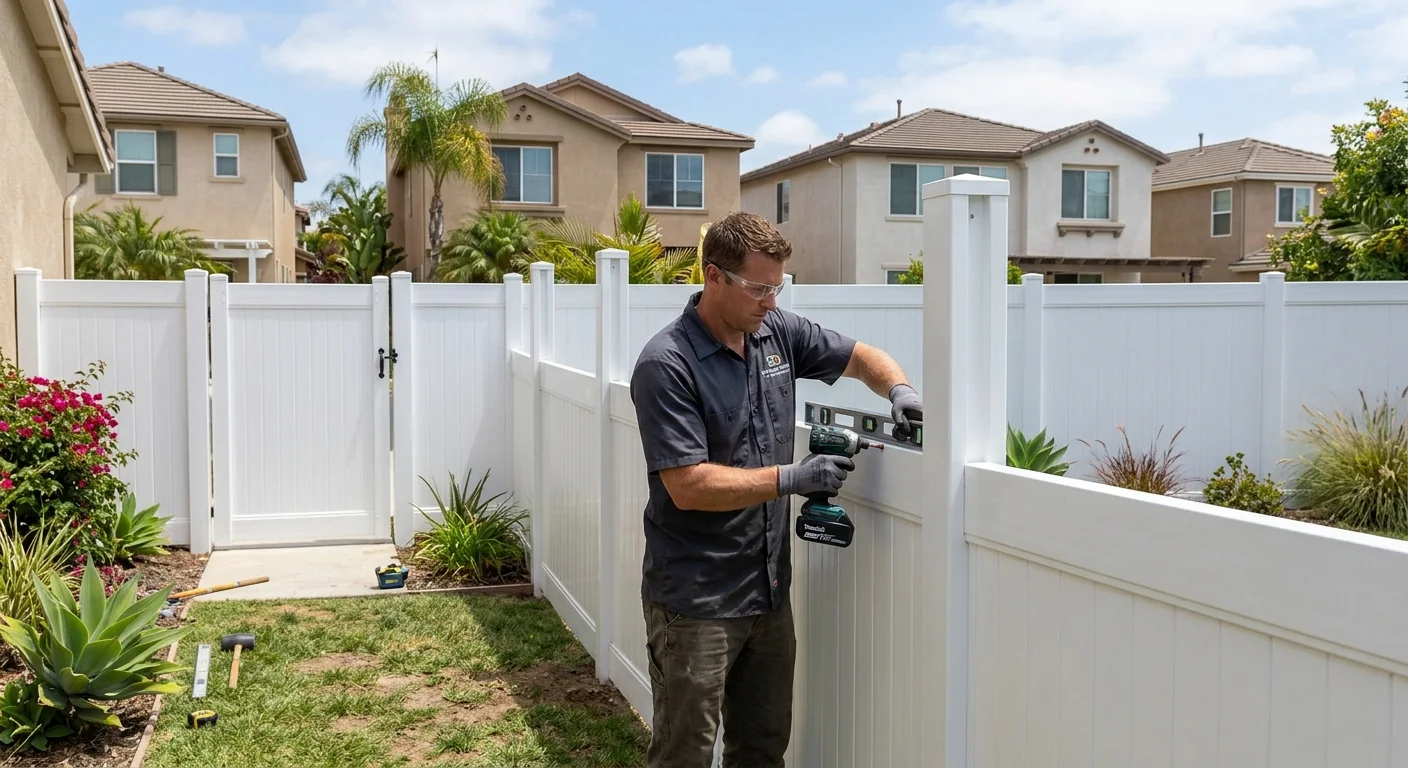
Vinyl privacy fence installation fails at the posts more often than at the pretty face. Panels are modular. Posts are structural. A written proposal should name line posts, end posts, corner posts, and gate posts as separate items. Routed line posts keep a straight run. Corner posts take the turn. Gate posts carry the leaf. Mixing a standard line post into a gate opening is a common shortcut. Make the contractor write the post type next to each opening.
Ask what sits inside the post. Some vinyl posts are hollow vinyl only. Some take a steel or aluminum insert, especially at gates and at the ends of a long bay. This page will not pick a wall thickness for you. Competitors sell that as a slogan. You want the spec on paper: post size, insert, cap, and how the post is set. Concrete footings are the usual in-ground method. Surface-mount on a patio slab is a different system. If the yard is a mix of soil, mow strip, and existing concrete, the proposal should split those conditions.
Gates are where a vinyl privacy fence stops being a panel and starts being hardware. A walk gate is one leaf. A double drive gate is two. Each needs a matching infill, a hinge set rated for the weight, and a latch that actually meets. Sag shows up first at the gate. Write the opening width, the swing direction, and whether the latch is a privacy latch or a pool-compliant device. If you need a driveway leaf, that is a separate conversation from a side-yard walk-through. See vinyl fence gates in San Diego for the gate-specific checklist.
Finish details sound small until they are missing. Post caps, color, and the top rail style change the whole elevation. White is the default in a lot of county tracts, and it shows dirt. Clay, tan, and gray hide dust better on inland lots, if the HOA allows them. Lattice or spindle toppers change privacy and can change height review. If you want a closed screen, say “solid privacy, no lattice” in the scope. If you want a topper, name the height of the solid portion and the topper separately so the total does not surprise planning staff.
Slope is a San Diego constant, from Mission Hills to Fallbrook. Vinyl privacy systems step or rack. Stepping makes a stair of level panels. Racking follows the grade. Not every panel style racks. Ask which method the product supports, and walk the line with the contractor. A stepped white vinyl privacy fence on a canyon lot will show triangular gaps under the panels unless those gaps are planned. Write the method, not “install on grade.”
Site access belongs in the same writing. A 6-by-8 panel does not walk through a locked side yard in South Park the way a stack of cedar boards does. Note the path from the street, any HOA staging rules, and who hauls the old fence. For how the install itself is sequenced, read vinyl fence installation in San Diego.
When repair and a vinyl privacy replacement deserve separate quotes
Do not let a full-yard vinyl privacy replacement hide inside a repair ticket. Vinyl is sectional. A cracked picket, a separated rail, or a leaning post is a different job from a new closed screen around the whole lot. Ask for two scopes when both are on the table.
Repair is the right first look when the posts are still plumb, the color still matches, and the damage is local: one bay a car tapped, one gate that no longer latches, one post the irrigation line undercut. A licensed C-13 fencing contractor can often replace a panel or rebuild a gate without touching the rest. California’s C-13 classification covers fences, posts, and gates. It excludes masonry walls. If the “fence” is actually a block wall with a vinyl screen on top, that is two trades.
Replacement deserves its own quote when the color no longer matches, several posts have rotated, or you are changing height, color, or the privacy style. Mixing a new white bay into a ten-year-old sun-faded run will read as a patch from the alley. South- and west-facing vinyl can chalk. That is a comparison item, not a lifespan claim. If discoloration is the complaint, assess it before you buy a new kit. Vinyl fence discoloration is the local write-up.
Shared property lines add a third quote path. California Civil Code §841 presumes adjoining private landowners share equally in the reasonable cost of a dividing fence, unless a written agreement says otherwise. Before you incur those costs, you must give 30 days’ written notice that describes the problem, the proposed work, the estimated cost, the sharing plan, and the timeline. The presumption can be overcome if equal shares would be unjust. The statute does not apply to government landowners. If the neighbor is on the hook, get the notice right before anyone orders panels.
Small, casual work under California Business and Professions Code §7048 can fall under the $1,000 aggregate licensing exemption when it is minor, does not need a permit, and is not advertised as contractor work. A full vinyl privacy fence around a typical San Diego backyard is not that job. Treat a yard-length replacement as licensed C-13 work. Check the contractor on the CSLB license lookup before you sign.
If only posts are failing, keep fence post repair as a separate line. If the old wood screen is coming down and vinyl is going up, demolition, haul-off, and the new system should not share one vague “replace fence” sentence.
What to compare before choosing a vinyl privacy contractor
You are hiring an independent licensed fence contractor, not a store aisle. Fence Pros San Diego is a referral service. We match you with licensed local pros. We do not install, we do not own the trucks, and we do not set the price. The contract is between you and the contractor.
Compare apples. Give every bidder the same sketch: closed vinyl privacy, height at each elevation, color, post types, gate count and swing, slope method, demolition, and who pulls any permit the city or county actually requires. Then compare the written system, not the friendliest walk-through.
License first. Confirm a current C-13 on the CSLB site. Ask who is on site, because the person who sold the job may not be the person who sets posts. Ask how they handle a shared line, a coastal overlay, and an HOA submittal. Those are San Diego problems. A catalog panel width will not solve them.
Walk the product, not the brochure. Hold a sample in the actual sun. White vinyl privacy fence looks cooler on a north side in Point Loma than on a west lot in El Cajon. Check rail reinforcement, how the infill locks, and how a cut end is finished. Ask what happens if one bay is damaged next year: a matching panel, a full-run color problem, or a different SKU. Manufacturer warranties, if any, are the manufacturer’s. Get the sheet. Do not treat a sales promise as a county rule.
If privacy is the goal and vinyl is only one candidate, read best privacy fence options in San Diego before you lock the material. If vinyl is already the call, stay on the posts, the gates, and the writing. The contractor who itemizes those is the one you can hold to the job.
When to call us
Call when you want a closed vinyl privacy fence compared as a full system, or when a repair and a replacement are getting mixed into one vague quote. Licensed C-13 fence contractors handle the posts, panels, and gates. Call us at (858) 400-4906 and we’ll connect you with a licensed fence contractor.