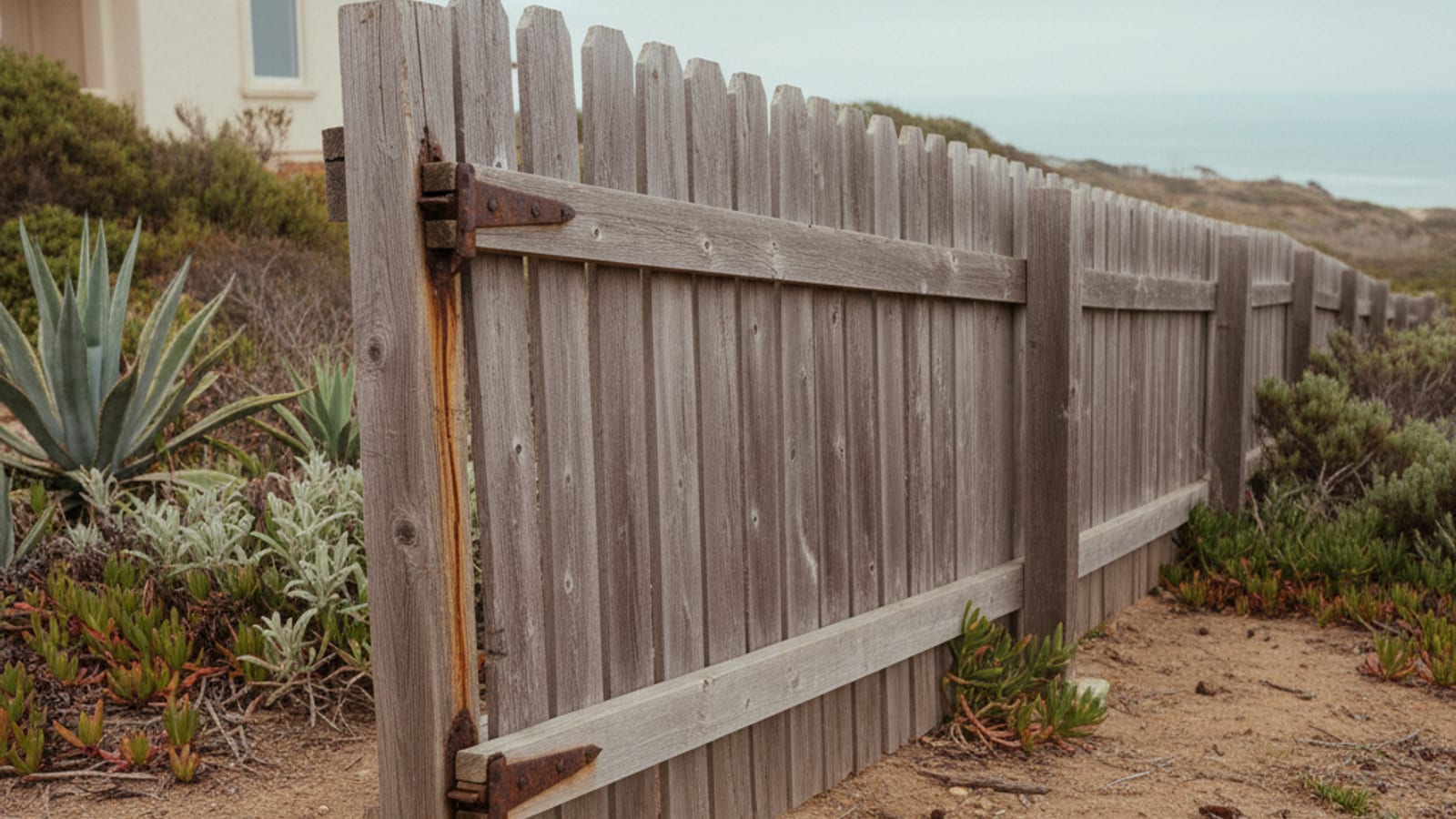
If a coastal San Diego fence a few years old already has rust streaks from nails, hinges, or post caps, that is typical zinc-plated hardware in salt air, not bad luck. Standard interior-county fittings are not a marine spec. Fence Pros San Diego is a referral service. We do not publish hardware dollar adders, a fence life in years, or a repair-trip ROI.
Here is what to specify in Encinitas, Carlsbad, La Jolla, Del Mar, Coronado, and Imperial Beach, and what to refuse on the bid.
What salt air does to metal
Sodium chloride in the marine layer sits on metal, holds moisture, and speeds oxidation.
Qualitative ranking for fence hardware within a couple of miles of the ocean:
- Bare steel: rusts fast. Not a coastal fastener.
- Zinc-plated (common big-box): thin coating. Often the source of brown streaks on pickets.
- Hot-dip galvanized: thicker zinc. Lasts longer than plating. Still not stainless.
- Stainless (304, with 316 as the marine step-up): the usual “no orange streaks” pick for nails, hinges, and latches. It is not magic if the grade is wrong or the installation mixes metals badly.
- Aluminum: no rust streaks like iron. Can pit. Powder coat helps if it stays intact.
- Powder-coated steel: fine until a chip. Then the steel rusts.
We will not timestamp “fails in 18 months” or call stainless “permanent.” Distance from surf, irrigation overspray, and whether the part is a nail versus a hinge change the clock. Treat Encinitas, Carlsbad, La Jolla, Del Mar, and Pacific Beach as coastal installs even if the lot is not on the sand.
Cost order is zinc, then hot-dip, then stainless 304, then 316. How many times more is a supplier quote, not a blog multiplier.
Where the hardware fails first
Picket nails. Most numerous. Zinc nails streak every board.
Lag screws at post-to-rail. Structural. When they waste, the rail loosens.
Gate hinges. Load plus exposure. Zinc hinges and screws loosen together. If the leaf drags, see gate repair.
Latches. High-touch. They get stiff, then they fail.
Post caps and decorative metal. Visible stains.
Chain-link tension bands, ties, and bottom wire. Mesh sags when the fittings go. Vinyl-coated or aluminized wire belongs in the coastal spec, not bare galvanized line wire.
Material picks (spec, not a price)
Cedar privacy, coastal spec
- Western red cedar pickets and rails (cedar resists rot better than untreated pine; it is not a warranty).
- Pressure-treated posts below grade.
- Stainless ring-shank nails for pickets.
- Stainless or hot-dip lags for rails.
- Stainless gate hinges, latches, and fasteners.
- Stainless or hot-dip post caps.
- Penetrating oil stain, not a thick film that peels in salt air. Staining is a separate fence staining job unless the contract includes it. Nobody here stains “every” coastal install by default.
Vinyl privacy
- UV-stabilized PVC with a wall thickness named on the product sheet. We do not invent a Class-A mil spec here.
- Routed rails; aluminum insert in gate posts if the manufacturer requires it.
- Vinyl or coated visible parts; stainless inside the gate hardware.
- No picket-face nails, so no nail streaks. Gates still need metal.
Chain link
- Vinyl-coated mesh.
- Hot-dip or coated posts and rails.
- Stainless or coated tension bands and ties.
- Stainless gate hardware.
Ornamental
- Powder-coated aluminum is the coastal metal that does not rust.
- Powder-coated steel still rusts at chips.
- Stainless fasteners only.
What to refuse
- Untreated pine or similar as the coastal picket.
- Zinc-plated nails and lags.
- Bare galvanized chain link as the waterfront mesh.
- Film-forming paint or thick acrylic as the only wood finish.
- Unnamed “residential” gate kits with no stainless or hot-dip callout.
- Unbranded thin vinyl with no UV sheet.
”Doing it right” without fake ROI
Stainless and hot-dip cost more than zinc. A retrofit of nails, hinges, latches, and caps can still be cheaper than rebuilding a structurally sound cedar fence. We will not invent a $9,000 fence, a $400 premium, or a $5,000 savings. Ask for a hardware line item versus a full rebuild line item.
Retrofitting an existing coastal fence
If cedar is still sound and the defect is orange streaks:
- Pull zinc picket nails. Replace with stainless ring-shank.
- Swap gate hinges and latches to stainless.
- Replace bleeding post caps.
- Sand rust stains and re-oil.
That is a common fence repair in Encinitas and Carlsbad. If posts are rotten at grade, hardware is not the job.
Vinyl as the low-visible-metal option
Pickets slot into rails. Caps are usually vinyl. The remaining metal is mostly gate hardware, which you can specify stainless. Wood-look vinyl is a look choice, not a claim that vinyl never chalks.
Frequently asked questions
How far from the ocean does salt air affect a fence?
Problems cluster near the shoreline and stay relevant a couple of miles inland. Treat the listed beach cities as coastal. Exact months-to-failure is not a number we have on invoices.
What is the best fence material for coastal San Diego?
For least visible rust: vinyl or aluminum systems with stainless gate parts. For wood: cedar plus stainless fasteners and a penetrating oil. There is no single winner for privacy, HOA, and budget together.
How much more does a coastal-spec cedar fence cost?
The hardware and stain lines cost more than zinc and a big-box film. Get it as a delta on the bid. We do not publish a percent or a dollar premium.
Can I retrofit, or do I need a full replacement?
Retrofit when wood is sound and hardware is the failure. Replace when posts or rails are gone. Send photos; the matched contractor still has to see the posts.
Do I need a permit to replace fence hardware?
Like-for-like hardware on an existing legal fence usually is not a building permit. City Table 142-03A still requires a building permit for a fence 7 feet or taller. County PDS 070 excepts qualifying fences not over 6 feet. New height, new location, coastal overlay, or a pool enclosure can change that. Fence installation and permits.
How often should a coastal cedar fence be re-oiled?
When the wood looks dry and the water no longer beads, not on a blog calendar. Penetrating oils fade. Film finishes peel. Product brand is the contractor’s spec, not a Fence Pros endorsement.
What a coastal quote should say
Stainless (or named 316 where spray is direct) as default fasteners and gate hardware, hot-dip as the zinc upgrade, penetrating oil on wood. Budget zinc on a waterfront bid is a future repair. If you are in Oceanside, La Jolla, Del Mar, Pacific Beach, Coronado, Imperial Beach, or Solana Beach and the fence is streaking, photos help decide retrofit versus rebuild.
Call (858) 400-4906 and we will connect you with a licensed fence contractor. You contract with that contractor directly.