A Vista driveway that climbs off Sycamore or drops into a cul-de-sac needs a different automatic gate than a flat Shadowridge pad. Swing and slide operators fail in different ways on grade, inland heat, and tight side yards. Compare those pieces first, then the quote.
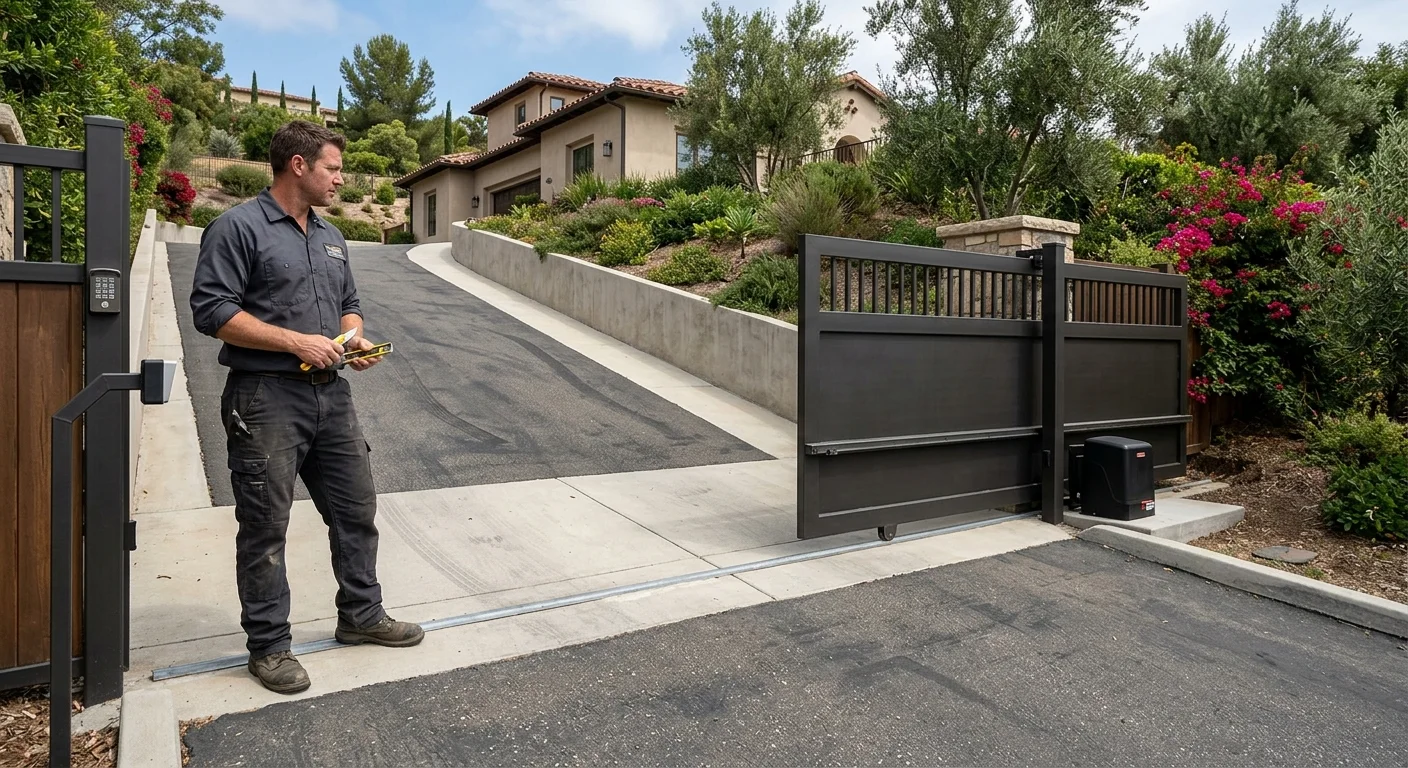
How Vista lots and driveway grades shape swing and sliding automation
Vista sits in inland North County, east of Oceanside’s marine layer. That layer often thins before it reaches Warmlands, Brengle Terrace, and the pads above Foothill Drive. Operators sit in that heat. Dry-summer dust coats photo eyes and slide tracks. Santa Ana wind days push on a tall leaf the way coastal salt never will. The independent installer should talk about shade for the operator, cover for the controls, and how the hardware will live through July and October, not only how it looks on day one.
Lot shape decides the hardware before product names do. A Shadowridge lot with a long, gentle apron can take a dual swing if the leaves have room to open without crossing the sidewalk or a neighbor’s wall. A downtown Vista lot on a short pad, off Santa Fe or near the civic core, often does not. The apron is tight. The sidewalk is close. A swing leaf that opens toward the street can hang into the public way. A swing leaf that opens into the property can block the only parking stall.
Grade is the other fork. Warmlands and the hills toward Buena Creek put real slope under the first stretch of driveway. A swing operator that has to lift a steel or wood leaf uphill every cycle works harder than the same unit on a flat Rancho Vista pad. If the leaf swings downhill toward the street, gravity helps it open and fights it closed. That is a mechanical problem, not a cosmetic one. Ask the installer to walk hinge geometry, operator sizing, and whether the posts can take that load. A pretty leaf on a tired post is how automatic gates start calling for Vista fence repair before the first year is out.
Sliding automation is the usual answer when the leaf cannot swing. It needs a clear run along the fence line, about the width of the opening, plus room for the operator and the stops. Vista side yards are mixed. Newer planned streets can spare that run. Older lots with a side house, a retaining wall, or a mature pepper tree often cannot. If the track would sit on a slope, the installer has to explain how the gate stays true. A rack that climbs or a cantilever that fights a curve is a service call waiting.
The county-wide picture of automatic driveway gates in San Diego still holds. Vista just makes grade, heat, and side-yard pinch the first three questions, not an afterthought.
What width, side clearance, and street access change in the plan
Opening width is not the same as driveway width. Measure the clear space between posts, then measure how a truck, an SUV, and a guest car actually turn in from the street. On E. Vista Way and the busier stretches of Melrose, traffic does not wait while a leaf creeps open. A driver who has to pause in the travel lane needs a plan that opens fast enough and wide enough that the car is fully on the property. On a quiet cul-de-sac the same delay is only an annoyance. Write that difference into the spec.
Side clearance is the silent deal-breaker. Swing leaves need an arc. That arc has to miss walls, meters, AC pads, irrigation boxes, and the neighbor’s fence. Slide leaves need a stack-back lane. That lane has to miss the same clutter, plus any grade change along the fence. Walk the line with the installer. Mark the meter, the SDG&E service, the hose bib, and the tree. If the only path for a slide is through a slope or a wall, you are not looking at a slide. You are looking at a rebuild of the approach.
Street access changes the hardware too. Short downtown aprons leave little room between the gate and the sidewalk. Long private drives off the Warmlands and Buena edges give you depth, then add a second problem: visitors, deliveries, and trash service have to reach a keypad or a call box from the driver’s seat. Place those controls where a sedan and a high truck can both reach them without hanging into the street. If the gate sits close to the right-of-way, ask the installer how the open leaf, the keypad post, and any loop in the pavement stay on your lot.
Think through daily traffic, not a brochure photo. Two cars that leave at the same hour. A trailer. A contractor van. Pedestrians on the sidewalk. A slide that opens only after a car is fully off the street. A swing that opens into a slope and stops short. Each of those is a layout choice. Get it on the drawing before anyone talks about finish color.
Which power, controls, and safety features belong in writing
Power is a site fact in Vista, not a preference. Hardwired operators need a real path from the panel to the post. That path may mean trenching across a driveway, boring under concrete, or running along an existing fence. Solar can look tempting on inland lots with long sun hours, but heat, dust, and shade from a two-story house or a mature tree all cut output. Do not let a quote say “solar” or “110” and stop there. Ask where the operator gets power, who runs that work, and what happens when the grid drops during a Santa Ana wind event. Battery backup belongs in the same paragraph. If it is not on the page, it is not in the job.
Controls should match how the house is used. Remotes for the cars that live there. A keypad for guests. A loop or a free-exit sensor so you are not reaching out the window every afternoon. Phone or app control if you want to let someone in from work. Intercom if the drive is long enough that you cannot see the street. Write the list. Then ask each bidder to price that list, not a generic “automatic” line.
Safety features are comparison items you put in writing. Photo eyes at the right height. Reversing edges on the leaf. How the gate behaves if it meets a car, a bike, or a person. How it stops if a photo eye is filthy from inland dust. How you open it by hand when power is out. Manufacturer manuals and listing marks (look for the operator’s own documentation) are the source for those behaviors. This page cannot recite a Vista safety code for driveway gates, because a specific local rule was not confirmed in the claims ledger. Treat “what protects the opening” as a written scope item, then confirm any city rule with Vista staff, as the last section explains.
Do not bury electrical and control work in a lump sum. The gate installation scope should name the operator, the power path, the access devices, and the safety devices as separate lines. If the installer is a C-13 fencing contractor, that license covers constructing, erecting, altering, or repairing gates. It does not magically cover every electrical task. Ask who does the wiring, under which license, and how that person shows up on the paperwork.
How to compare two Vista automatic gate quotes
Two quotes are only useful if they describe the same Vista lot. Start with a site walk, not a number on a page. Same opening width. Same swing or slide. Same grade notes. Same post work. Same trenching. Same controls. If one bidder is automating the existing leaf and the other is replacing posts, leaf, and track, you are not comparing automatic gates. You are comparing two different jobs.
Ask each independent installer to put this on paper:
- Swing or slide, and why that choice fits this apron
- Leaf material and how the operator is sized for that weight
- What happens to existing posts, hinges, and hardware
- Power source, trench or solar path, and battery backup
- Keypad, remotes, loops, and any intercom
- Photo eyes, edges, and manual release
- Who pulls any city paperwork, if paperwork is required
- Who does electrical work, and under which license
Then check the license. California Contractors State License Board lets you verify a contractor license before you sign. Automatic gate work sits well above the $1,000 aggregate threshold in Business and Professions Code §7048 for unlicensed casual work, and that exemption also fails if the person advertises as a contractor. Use the CSLB tool. Match the name on the quote to the name on the license.
Watch for gaps that show up later on Vista lots. No mention of grade. No mention of heat or sun on the operator. No plan for dusty photo eyes. A slide quoted on a side yard that cannot take the run. A swing quoted on a short apron that opens into the sidewalk. A price that ignores post replacement on a 1970s pad. Those are not small misses. They are the job.
Fence Pros San Diego is a referral service. It matches you with licensed, independent local fence professionals. You contract with the installer directly. If you still need a local starting point on who does fence work in this city, read how to use a fence company in Vista next to this comparison, not instead of it.
Which property questions need official City of Vista confirmation
Vista is its own city. Do not borrow height, setback, or permit rules from the City of San Diego municipal code, and do not use unincorporated County PDS070 sheets on an in-city lot. Those sources do not govern Vista. Specific Vista setback, height, and permit figures for automatic driveway gates could not be confirmed in the claims ledger used for this site. The honest next step is to ask the people who actually issue the answer.
Call or visit City of Vista building and planning staff before you lock a design. Bring a simple sketch: opening width, swing vs slide, which way the leaf travels, how close the gate sits to the sidewalk, and whether any post or keypad would sit near the right-of-way. Ask, in plain words:
- Whether this gate needs a building or electrical permit
- Whether the open leaf, the track, or a keypad post may sit near or over the public way
- Whether the city has rules for driveway gates on your street type
- Whether emergency access hardware is required on this property
- Who, besides the city, has to sign off (an HOA, for example)
If staff cannot answer from the sketch, ask which application or counter they want you to use, and take that instruction to the installer. A quote that says “permits included” with no city named is not a plan.
HOA rules are a second track. Shadowridge and other planned pockets often have private design rules for street-facing gates. Those rules are not city code. Get the architectural packet in writing. Do not let an installer guess at color, opacity, or operator placement.
Property lines still matter even when the gate is only on your driveway. California Civil Code §841 covers shared boundary fences between adjoining private landowners, with a presumption of equal reasonable cost and a 30-day written notice before you incur shared costs. A driveway gate on your own apron is usually not a shared fence. The moment a post, a track, or a keypad sits on a line you share, stop and confirm the line. A survey beats an argument.
Until Vista staff answer the permit and right-of-way questions, treat every setback, height, and safety measurement you hear on a sales call as unverified. Confirm it. Then put the confirmed answer in the scope.
When to call us
Call when the Vista lot is real, the swing-versus-slide choice is still open, and you want a licensed independent installer to walk grade, clearance, power, and controls before anyone orders an operator. Fence Pros San Diego matches homeowners with licensed fence contractors. You hire and pay the pro directly. Call us at (858) 400-4906 and we’ll connect you with a licensed fence contractor.