Automatic driveway gates in San Diego run $1,200 to $3,200 installed for a residential swing gate and $1,500 to $2,800 for a sliding gate, operator and labor included. Heavy ornamental iron gates or commercial-grade operators run $3,000 to $6,000, and trenching conduit through a paved driveway adds $400 to $900. Your driveway layout decides the gate type before your budget does: swing gates need clearance to arc open, sliding gates need level space to run parallel to the fence, and solar openers add $300 to $600 but skip the trenching. Here’s how the choices stack up, what the electrical work involves, and what each option costs across San Diego County.
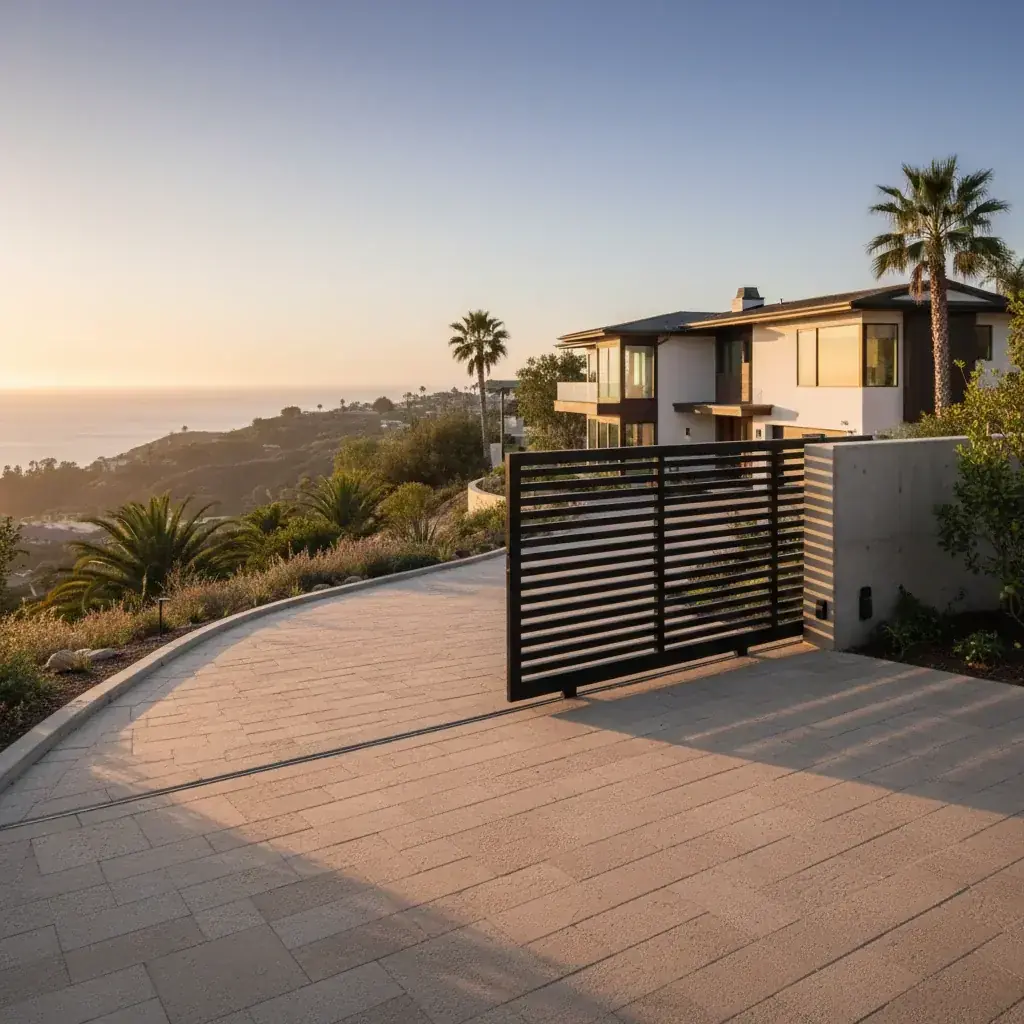
What does an automatic driveway gate need in San Diego?
An automatic driveway gate in San Diego needs three things settled before anyone orders parts: whether the opening takes a swing or a slide, whether power already reaches the gate or conduit has to be trenched, and which entrapment-protection sensors the operator requires. Coastal properties add corrosion-resistant hardware to that list.
Swing vs sliding: which gate fits your driveway
The layout of your property decides this before your budget does.
Swing gates need clear space behind the gate panels to arc open, typically 1.2 to 1.5 times the gate width on each side. If you have a flat or gently sloped driveway and at least 10–12 feet of clearance inside the gate line, swing is usually the simpler and less expensive path. Single-arm operators are less mechanically complex than sliding track systems, and repair access is easier.
Sliding gates roll parallel to the fence line and require a straight, level track run equal to the full gate width plus a few feet of overrun. That means a 16-foot driveway opening needs roughly 18–20 feet of unobstructed space beside it. Hillside properties in neighborhoods like Scripps Ranch, El Cajon, or Rancho Bernardo often don’t have that lateral room, but they also can’t use swing because the grade would cause the gate to drag or fight gravity. In those cases, a cantilever slider (no ground track) is often the right call.
A few things that knock out swing immediately:
- A slope steeper than about 8% rising toward the house
- Parking that begins within 12 feet of the gate
- A circular driveway where inward swing would block a turning radius
If you’re not sure which applies to your property, walk the driveway with a tape measure before you call anyone. Knowing your opening width, the available side clearance, and the grade percentage gives any contractor a real starting point. The gate installation pros we match you with do a site assessment before quoting, layout surprises late in a project cost everyone time.
Gate opener types and what each one costs to install
Opener selection follows gate style, then power source, then feature set.
Swing gate openers
Single-arm electromechanical operators are the workhorse for residential swing gates. Brands like LiftMaster, Linear, and Ghost Controls all make reliable units in the $400–$900 range for the hardware alone. Installed with a hardwired power connection, expect total costs of $1,200–$2,200 for a single gate and $1,800–$3,200 for a dual-leaf configuration. The spread depends on whether conduit is already run, how far the operator sits from your panel, and whether a concrete pad needs to be poured.
Hydraulic ram operators are worth the price jump (often $2,500–$4,500 installed per leaf) on heavy ornamental iron gates above 400 lbs, or anywhere you need continuous-duty cycling, think a gate that opens and closes 40+ times per day for a rental or commercial property.
Sliding gate openers
Sliding operators are chain-driven or rack-and-pinion. For residential use up to 1,400 lbs, a rack-and-pinion unit like the LiftMaster LA500 or FAAC 740 handles most aluminum or light steel gates without issue. Installed cost runs $1,500–$2,800 depending on gate weight, track prep, and the power run.
Heavy ornamental iron sliders above 1,400 lbs move into commercial-grade operators ($3,000–$6,000 installed) and typically require a dedicated 20-amp circuit.
Solar vs. hardwired: Solar kits add $300–$600 to hardware costs but eliminate trenching to a power source. In San Diego’s sun, a solar operator on a moderately used gate (20–30 cycles per day) works reliably year-round. The trade-off is that solar units are typically lower-torque, which means they’re sized for lighter aluminum gates. If your gate is steel or over 600 lbs, run power.
Power, conduit, and what your electrician needs to do first
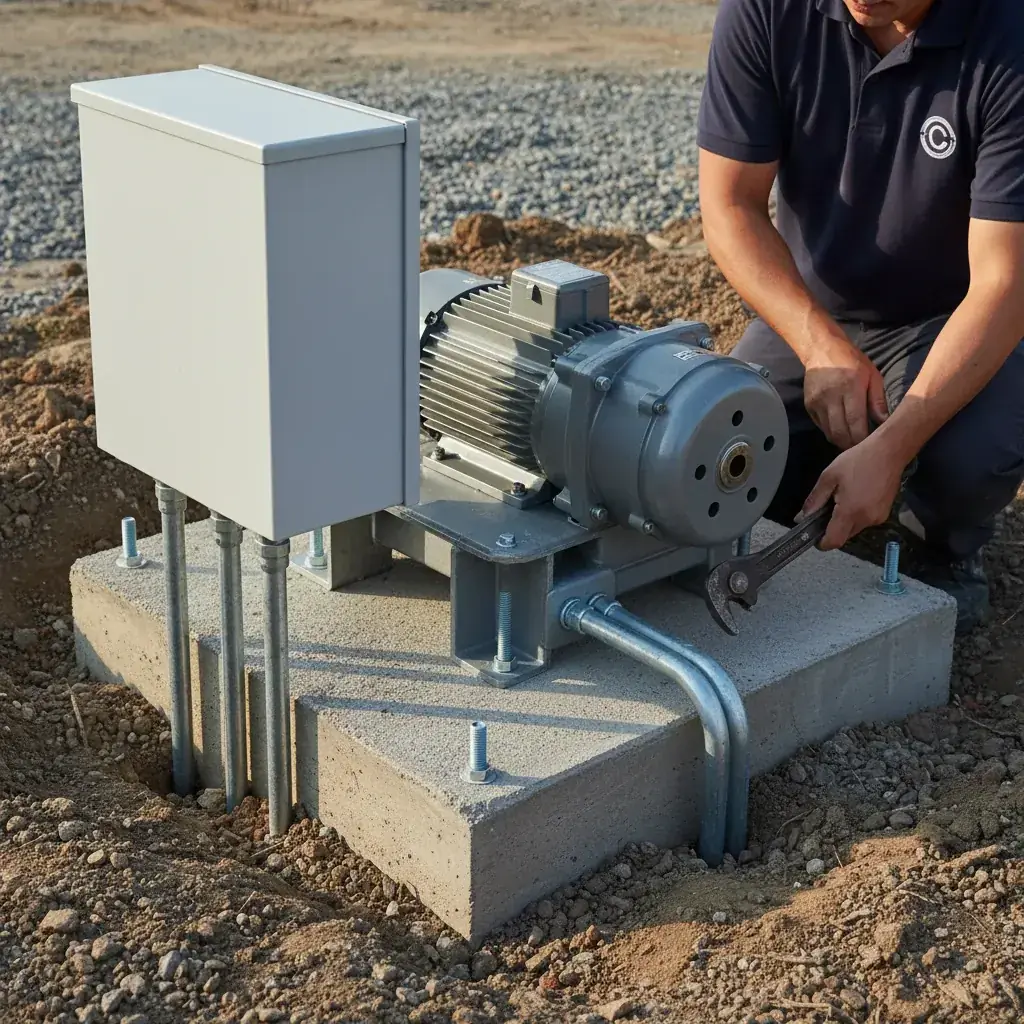
This is where projects stall. The gate contractor and the electrician need to coordinate, and most homeowners don’t realize the electrical work has to come first, or at least in parallel.
Most residential automatic gate openers run on 120V AC from a standard 15-amp circuit. Larger operators need a 20-amp dedicated circuit. The operator manual will spec it, don’t skip this.
What the electrician typically does:
- Pulls a permit if required (San Diego County residential electrical work over certain thresholds does require one, check with your local jurisdiction or review San Diego County’s permit requirements)
- Runs conduit from your sub-panel or main panel to a junction box near the operator location
- Buries the conduit at code depth (typically 12 inches for rigid metal conduit, 24 inches for PVC in a vehicle-traffic area)
- Lands the circuit and confirms voltage at the box before the gate contractor installs the operator
The gate contractor then mounts the operator, runs low-voltage wiring to access devices, and programs the system.
One thing that catches San Diego homeowners off guard: if your driveway is paved, trenching through concrete or pavers for conduit adds $400–$900 depending on run length and paving type. Get that cost on paper before finalizing the project budget.
The operator location matters too. Coastal areas, Encinitas, Del Mar, Pacific Beach, see salt air accelerate corrosion on exposed metal. Mount the control box in a NEMA 4X-rated enclosure or under a covered column if possible. We wrote more about how salt air affects hardware in our coastal fence hardware post.
Safety sensors, keypads, and remote access options
The operator motor is just one piece. The access control and safety system is where the project gets customized, and where costs climb if you want everything.
Safety devices (non-optional): Any UL 325-compliant installation requires entrapment protection. That means photo-eye sensors mounted 4–6 inches off the ground on both sides of the gate opening, plus an automatic reverse or stop function if the beam breaks during operation. Some operators also include edge sensors, pressure strips on the gate leading edge, for secondary protection. Don’t skip these. A gate that closes on a car, a dog, or a child is a liability and a heartbreak.
Entry devices:
- Keypads: Surface-mount wireless keypads run $80–$200 in hardware. They’re the standard choice for family use.
- Key fobs / remotes: Most operators include two remotes. Additional fobs are $25–$60 each.
- Vehicle loop detectors: An in-ground wire loop under the driveway triggers the gate to open as a vehicle approaches from inside. This is the exit-side solution that replaces the “push a button to leave” step. Loop installation adds $300–$600 to the project.
- Intercom and video: Wired intercom systems with camera integration (like the DoorBird or Aiphone JO series) run $500–$1,500 installed. They work with most modern operators via a relay trigger.
- Smart access (phone-based): LiftMaster’s myQ platform, FAAC’s XBAT, and a handful of third-party controllers let you open the gate from a phone app, see entry logs, and integrate with smart home systems. Hardware kits are $100–$300 depending on the platform. If you already have a Ring or Google Nest ecosystem, check compatibility before buying.
If you’re comparing this project to other gate repair or upgrade work you might need, our post on what to do when a fence gate won’t latch covers the mechanical side of gate alignment, which matters if the gate frame itself needs work before automation.
Maintenance schedule for coastal San Diego properties
An automatic gate has more moving parts than a passive one, and the coast accelerates wear on all of them.
Monthly:
- Test photo-eye alignment, walk through the beam and confirm the gate stops or reverses
- Wipe salt and dust off the photo-eye lenses with a soft cloth
- Listen for grinding or hesitation in the operator cycle (early warning of rack wear or low lubrication)
Every 3–6 months:
- Lubricate the gate hinges or slide rail with a silicone-based lubricant (not WD-40, which attracts grit)
- Check operator mounting bolts for looseness, vibration cycles loosen hardware over time
- Inspect the battery backup if your unit has one, coastal humidity shortens battery life
Annually:
- Have the operator’s clutch/torque settings checked by a technician, settings drift, and a gate that pushes too hard against an obstruction defeats the safety system
- Inspect conduit entry points for water intrusion; reseal if caulking has cracked
- Test the manual disconnect and confirm everyone in the household knows how to use it
Salt air, sand, and the occasional Santa Ana wind make San Diego harder on gate hardware than inland climates. Properties within a mile of the coast should run on the more aggressive end of this schedule. Verify your installer is licensed before any electrical work by checking their CSLB status at the California Contractors State License Board.
Automatic driveway gates in San Diego: coverage and next steps
Fence Pros San Diego connects homeowners with independent automatic gate installers across San Diego County, from coastal neighborhoods like Encinitas and Del Mar to inland cities like El Cajon, Carlsbad, and Rancho Bernardo. If you’re comparing gate types, call us at (858) 400-4906 and we’ll connect you with a licensed independent contractor who can assess the driveway and prepare a proposal.
Frequently asked questions
How much does an automatic driveway gate cost in San Diego?
A residential automatic driveway gate runs $1,200 to $3,200 installed for a swing gate and $1,500 to $2,800 for a slider, including the operator and labor. Heavy ornamental iron gates or commercial-grade operators run $3,000 to $6,000. If your driveway is paved, trenching conduit through concrete or pavers adds $400 to $900.
Should I get a swing gate or a sliding gate?
Your driveway layout decides, not your budget. Swing gates need 10 to 12 feet of clearance behind the panels to arc open and a near-level grade. Sliding gates need level space beside the opening equal to the full gate width plus a few feet of overrun. Hillside lots in Scripps Ranch, El Cajon, and Rancho Bernardo usually can’t fit either cleanly and end up with a cantilever slider that uses no ground track.
Do I need a permit for an automatic driveway gate in San Diego?
The gate itself follows standard fence and gate rules, but the electrical work to power the operator often needs a permit. San Diego County requires permits for residential electrical work over certain thresholds, and your electrician pulls it as part of the rough-in. Our San Diego fence permit guide covers the fence side of the rules.
Which San Diego cities do you install automatic driveway gates in?
Fence Pros San Diego connects homeowners with automatic gate installers across all of San Diego County, including National City, Imperial Beach, Lemon Grove, El Cajon, Poway, and Carlsbad. The network also covers rural drives, where long private roads and horse property make a gate a real security upgrade, including driveway gates in Ramona and Jamul. Coastal addresses in Carlsbad and Encinitas need corrosion-rated enclosures for the control box, while inland hillside lots in El Cajon and Poway often need a slider instead of a swing gate because of the grade.
How much does an automatic driveway gate cost in Vista?
The same price ranges apply in Vista as in the rest of San Diego County: $1,200 to $3,200 installed for a residential swing gate and $1,500 to $2,800 for a sliding gate, operator and labor included. Vista’s hillside lots in the eastern part of the city often require a slider or cantilever configuration rather than a swing gate, which can push costs toward the higher end of that range. If you’re on a paved driveway and need conduit trenched through concrete, add $400 to $900. Learn more about our automatic driveway gate installation in Vista.
How long does an automatic gate take to install?
Most residential installs take one to three days once the electrical rough-in is done. The electrician runs conduit and lands the circuit first, then the gate contractor mounts the operator, wires the safety sensors, and programs the keypads and remotes.
When to call us
Automatic gate installation can involve electrical work, concrete or paving, and safety equipment. If you’re not sure whether your driveway layout supports swing or slide, call us at (858) 400-4906 and we’ll connect you with a licensed independent gate professional who can define the project scope.