A cattle fence on a Ramona pasture is a working line, not a backyard screen with cows in the photo. Cattle lean, scratch, and test corners. Inland ground is granite, clay, or river silt depending on the road. If you need ranch cattle fencing in San Diego County, split the job into pasture, perimeter, and corral before a licensed independent fence contractor writes the scope.
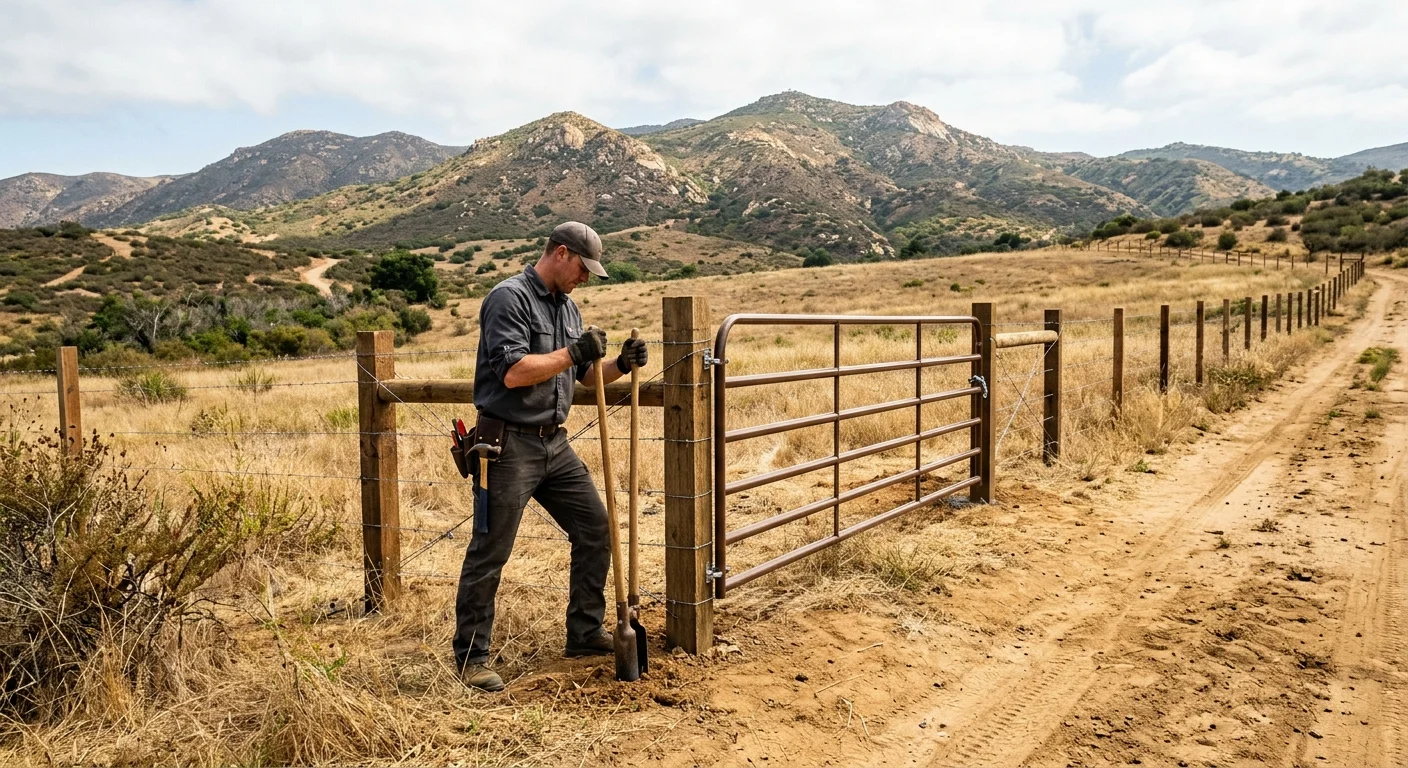
How cattle fencing differs from horse, garden, and yard fencing
Yard and garden fences fail first under livestock pressure. A steer uses a line as a scratching post. A calf finds the lowest gap. A bull loads a corner. Privacy boards, light garden mesh, and decorative hog wire for a patio were never built for that.
Horse fencing is a different problem. On a horse property in San Diego County, the usual worries are visibility, a kick rail, and a hoof or shoe catching in mesh. Cattle work is bulk and lean. The herd walks the fence. That is why a cattle panel fence shows up in handling pens, alleys, and crowding areas more often than as the skin of a long pasture. A long pasture run is usually a wire system. Rigid panels still need posts or a frame. They do not stand as a mile of fence by themselves.
A farm fence plan often mixes goats, poultry, and cattle on one parcel. This page stays on cattle. Mixed stock changes openings, gate height, and how tight the bottom needs to be. Do not copy a goat or horse spec onto a cattle job and call it done.
People searching “cattle fence” usually mean one of these systems. None of them is a universal best. The right mix depends on herd, parcel, and which run you are building.
High-tensile wire is the common conversation for long pasture and cross-fencing. Strand count is not a number we can publish as a county rule. It belongs in the contractor’s written spec for your animals and your line.
Woven wire, often sold as field fence, gives a physical mesh instead of open strands. It can hold pressure better in some spots and create hoof-trap problems in others if the openings are wrong for the stock. That is a site call, not a catalog slogan.
Cattle panels are rigid welded grids. They earn their keep at corrals, squeeze approaches, and high-wear openings. They are a poor default for every acre.
Post-and-board can work on a small paddock where you want a visual rail. It costs more in material and upkeep than a wire pasture. Pairing board with a hot wire or another deterrent is a design choice the contractor should write down.
Electric wire is a teaching tool and a way to subdivide grazing. Treat it as part of a plan, not as the whole perimeter, unless the quote explains why.
Barbed wire still sits on older inland lines. Whether it belongs on a new cattle fence is a site decision. Split rail can mark a lane or a road frontage. It is not the working pasture fence for a herd.
California’s C-13 fencing contractor classification covers fences, corrals, runs, railings, posts, and gates. It excludes masonry walls. Verify the license on the CSLB license lookup before you sign.
Where Ramona, Fallbrook, Valley Center, and Bonsall layouts tend to split
San Diego County cattle country is inland. Encinitas and El Cajon are not the model, and neither is a coastal yard.
Ramona and the Santa Maria Valley still read as open pasture. Parcels off SR-67, Highland Valley, and the Warners side run long. Corners sit in Santa Ana wind. Granite and decomposed granite change how posts set compared with a watered suburban lot. Frost pockets and dry summers work wood and wire differently than a Fallbrook grove edge. Perimeter here is often expensive because of length, not because of a fancy board face.
Fallbrook sits on rolling avocado and ag hills above the San Luis Rey. Fence lines jog around groves, drainage, and steep cuts. A cattle fence here often shares the property with orchard access, so gates have to take a truck, not only a stock trailer. Shade and irrigation along grove edges rot wood posts faster than a dry Ramona ridge. Live Oak, Mission, and the De Luz-facing slopes are not one soil.
Valley Center, along Valley Center Road, Lilac, and Cole Grade, is mixed ag next to rural residential. Your cattle line may be a neighbor’s view fence. Shared boundaries matter more. California Civil Code §841 says adjoining landowners share equally in maintaining boundaries. It also presumes they share equally in the reasonable costs of building, maintaining, or replacing a dividing fence unless a written agreement says otherwise. Before you incur those costs, you must give 30 days’ written notice that describes the problem, the proposed work, the estimated cost, the sharing plan, and the timeline. The presumption can be overcome in court if equal sharing would be unjust. The statute excludes government entities. It still shows up more on a Valley Center or Bonsall lot than on a wide Ramona pasture.
Bonsall sits on the I-15 and SR-76 edge. River bottom to the west, hills to the east. Parcels can be tighter. Handling areas end up closer to the house or barn. A cattle fence that also has to look finished from Camino Del Rey is a different quote than a back-forty wire run.
Do not paste a Fallbrook grove layout onto a Ramona grassland. Slope, water, wind, and neighbors change post work, brace count, and the gate map. Put the address in the scope.
What posts, braces, gates, and handling-area details belong in writing
Cattle jobs fail at corners and openings, not in the pretty middle stretch.
Posts should be specified: wood species or steel class, size, and how they are set. “How deep should fence posts be set” is a real search. There is no single verified countywide depth in our claims ledger. A number copied from a Midwest DIY article is not a San Diego spec. Ramona granite, Valley Center clay, and Bonsall river silt do not take the same footing. Ask the licensed contractor to write depth, backfill, and whether concrete is used. If a permit drawing is required, confirm that detail with the County of San Diego or the city that governs the address.
Braces carry the line. End braces, corner braces, and gate posts take the load. If the quote is silent on braces, the quote is incomplete.
Gates belong in the first drawing. Field gates for equipment, smaller man gates, and a plan for how cattle move through the place. Adding a gate later is a rebuild of that span. A cattle panel opening at a corral is not the same as a pipe gate on a pasture. Width, swing, and ground clearance should be in writing.
The handling area is its own build. Alleys, crowding pens, and the last panel before a chute take more abuse than a cross-fence. Cattle panels and heavier frames belong in that conversation. Rigid panels still need posts or a frame.
Where to buy cattle panels is a common question. Farm and ranch suppliers inland stock them. Fence Pros San Diego does not sell panels and does not run a yard. On a fence installation job, the licensed contractor you contract with usually sources material to the spec they will install. You pay that contractor directly.
Write each run as line type, post spec, brace method, gate schedule, and what happens at grade changes. If it is not in writing, it is not in the job.
When pasture, perimeter, and corral runs deserve separate quotes
One lump “cattle fence” figure hides three different builds.
Pasture and cross-fence are long. Material per foot is often simpler. Length is the cost driver. High-tensile or woven field fence is the usual conversation. Temporary electric can subdivide grazing. That is still a different product than the permanent outer line.
Perimeter is the legal and neighbor line. It may need to match an existing fence, sit on a surveyed line, and take vehicle gates. On unincorporated land, County of San Diego Planning & Development Services handout PDS070, revised 2023-01-01, lists a permit exemption for fences and walls no higher than 6 feet if the work is zoning compliant. That same public zoning summary lists 42 inches at front and exterior side, and 72 inches at rear and interior side. Confirm current applicability for your parcel. An exemption is not zoning compliance, and it is not a livestock-containment rule.
Corral and handling are short footage and high wear. Panels, heavier posts, more gates. Mixing this into a pasture unit price makes the pasture look expensive and the corral look cheap, or the reverse.
Ask for separate line items: pasture, perimeter, corral. Then you can phase. Many inland owners fence the handling area first, then the home pasture, then the outer line.
Fence Pros San Diego does not set prices. The licensed contractor you contract with does.
Which livestock or permit questions need official confirmation
No livestock-containment height, strand count, or mesh opening is verified in our claims ledger. If a page tells you to use a set number of strands at a set height as a rule, treat it as marketing unless the County, a city, or a written standard for that parcel says so. We could not confirm a San Diego County livestock-fencing ordinance that publishes a cattle-specific strand or height spec. Confirm with County of San Diego Planning & Development Services for unincorporated land. If the address is inside Escondido, San Marcos, Oceanside, or another city, ask that city’s development services desk.
PDS070 heights above apply to unincorporated County only. Inside the City of San Diego, Municipal Code Chapter 14, Article 2, Division 3, Table 142-03A treats fences below 7 feet as no permit under that division, and 7 feet or greater as a Building Permit / Process One. Other design rules still apply, including coastal overlay caveats. Most cattle parcels are not in the City. Use that table only if the address is.
California Business and Professions Code §7048 exempts some casual, minor work when the aggregate contract is under $1,000 and no building permit is required. Dividing jobs to duck the threshold, advertising as a contractor, or employing others knocks the exemption out. A cattle fence is almost never that job. Hire a licensed C-13 contractor and check the license on CSLB.
Shared fences follow Civil Code §841, described above. Government land next to yours is outside that statute.
Wind ratings, wildland-urban interface material rules, and fire-resistant fence specs for a cattle line are not in our verified ledger. Do not treat pasture wire as a brush or fire requirement. Ask PDS and the fire authority that covers the address.
DIY hog-panel tutorials skip soil, braces, gates, and California licensing. A C-13 license covers fences, corrals, and runs. That is the classification to match.
When to call us
Call when a pasture, a perimeter, and a corral need one plan, and you want those runs priced as separate work by a licensed independent fence contractor. Fence Pros San Diego is a referral service. We match you with licensed local fence pros. We do not build the fence. Call us at (858) 400-4906 and we’ll connect you with a licensed fence contractor.