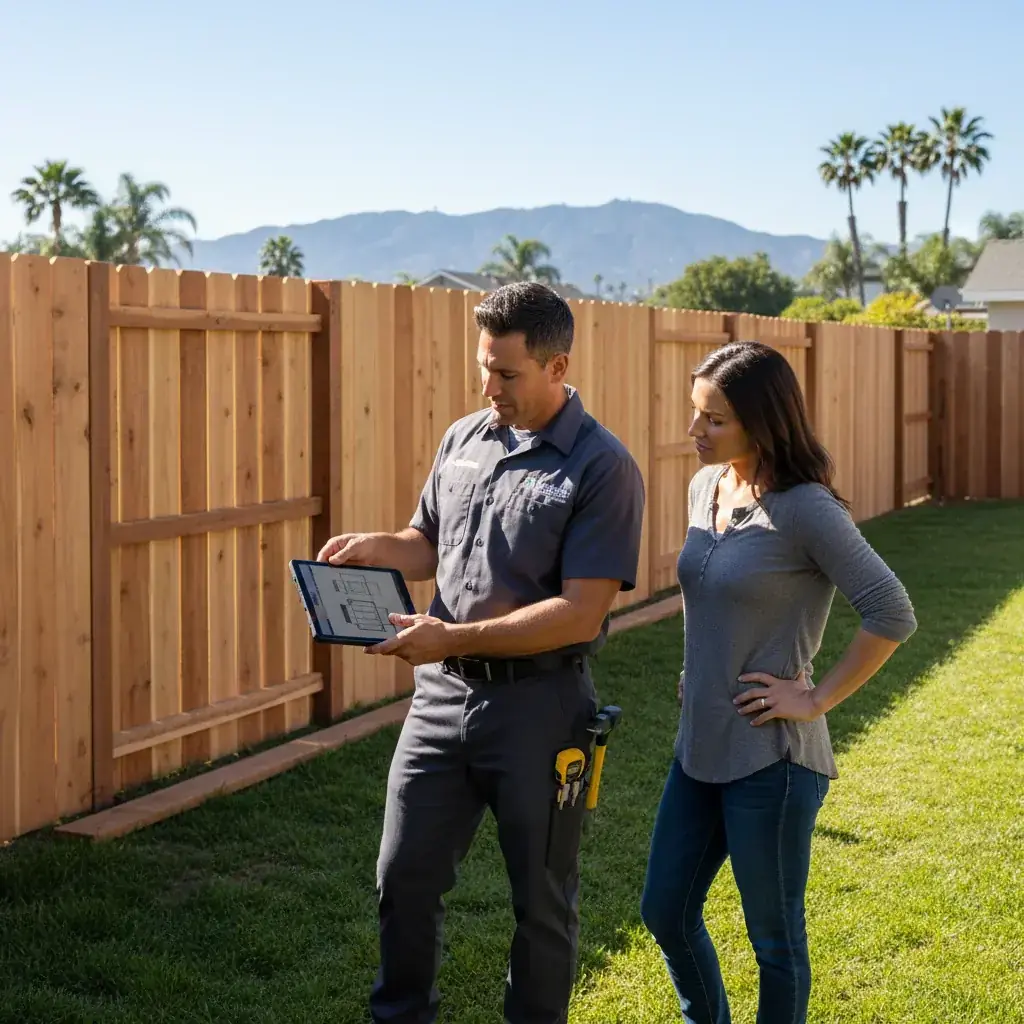
For most fence projects in California, the person you want is a licensed C-13 fencing contractor, not a general handyman. Business and Professions Code section 7048 exempts only aggregate contracts under $1,000 that are casual, minor, and do not need a building permit. A typical new fence or a multi-panel repair sits outside that exemption.
Fence Pros San Diego is a referral service. We do not employ builders, hold a C-13, set prices, or warrant workmanship. You contract with and pay the independent professional directly. Verify that person’s license yourself.
License, bond, and insurance: what to verify
A C-13 Fencing Contractor license, issued by the Contractors State License Board, authorizes construction, alteration, and repair of fences, gates, corrals, railings, and related barriers. It excludes masonry walls. Look the number up on the CSLB license tool. Confirm the license is current and that the name matches the proposal.
Ask for certificates of general liability and workers’ compensation that match that same name. Uninsured work on your property is a risk you should not guess about. Fence Pros San Diego does not certify that any referred professional is insured.
Do not treat a handyman listing as a substitute for an active C-13 on a job that needs one. Check the record rather than a verbal claim.
Questions that separate a fence specialist from a generalist
Do you specialize in fences?
A specialist should talk about post setting, gate sag, soil, and hardware in writing. A generalist who also hangs doors may still be licensed. The question is whether this proposal shows fence work.
How will you set posts on this lot?
Ask for hole diameter, depth, concrete mix method, and how they handle coastal sand versus inland clay or decomposed granite. County PDS 070 lists wood-post footing notes as recommendations only, including a 12-inch-diameter concrete note and about 24 inches into undisturbed ground or compacted fill, over gravel. That is not a citywide inspection checklist and not a frost-line rule. San Diego does not design fences around freeze depth. Get inches for this address in the bid.
What product are you actually installing?
Species and grade for wood, panel class for vinyl, coating for metal, and fastener schedule (stainless or hot-dip galvanized near salt air) belong on the page. “Wood fence” is not a spec.
Who confirms permits and HOA review?
Building permit and zoning height are different questions. In the City of San Diego, Municipal Code Table 142-03A, as used on this site’s permit guide, does not require a building permit under that fence division for a fence less than 7 feet, and requires a building permit at 7 feet or greater. Zoning, visibility triangles, and overlays are separate. Unincorporated County PDS 070 excepts qualifying fences not over 6 feet that also meet zoning, with a published zoning excerpt of 42 inches at the front or exterior side and 72 inches at the rear or interior side. Other cities use their own desks. Do not accept “most fences under six feet skip the permit” as a countywide rule.
HOA architectural review is private and parcel-specific. A contractor may assemble the packet only if the contract says so. Fence Pros San Diego does not file it. See fence installation and DIY vs hiring a pro.
Can I see recent local work?
Ask for addresses or photos of completed fence lines you can view from the street. That is a quality check, not a testimonial.
Red flags in a fence quote
A one-line total is hard to compare. Ask the proposal to name linear footage, height, style, gate count, demolition, haul-away, material grades, post and footing notes, and who pulls any required city paper.
Be cautious of cash-only deals and pressure to sign the same day. A fair quote includes the contractor’s name, address, CSLB number, scope, and a payment schedule you can read before work starts.
For material questions rather than invented market rates, use fence costs in San Diego. Fence Pros San Diego does not publish per-foot prices.
Warranties, lien releases, and payment
Manufacturer product warranties and installer workmanship terms are different documents. Get both in writing from the professional you hire, or note that none was offered. Fence Pros San Diego gives neither.
Ask how suppliers and any subcontractors will be paid, and whether you will receive lien releases with final payment. A mechanic’s lien on a house is a title problem, not a paperwork nicety.
Walk the finished line before the last payment. Punch-list items belong in writing.
How long the work takes
There is no verified day-count for a “standard” San Diego backyard in the approved claims ledger. Rocky soil, slopes, HOA review, and gate fabrication change the calendar. Ask for a written sequence: layout, post setting, any concrete cure the installer requires before hanging panels, then rails, boards, and gates. Be wary of a promise to complete a full new fence in one day if the same bid is silent on post cure. That is a question for the contractor, not a published network schedule.
Related repair work: fence repair.
Frequently asked questions
What license does a fence builder need in California?
Fence work generally needs an active C-13 Fencing Contractor license when the job is outside the small B&P 7048 exemption. Verify the number on the CSLB site. Unlicensed advertising and unlicensed contracting have their own penalties; look those up on current CSLB consumer pages rather than treating this page as legal advice.
How much does a fence builder charge per linear foot in San Diego?
Fence Pros San Diego does not publish per-foot rates. Compare itemized proposals for the same measured line. See the 2026 cost guide for questions to ask, not a price list from this brand.
Do I need a permit for a fence in San Diego?
It depends on the city or County desk, height, yard, and whether a pool is enclosed. City Table 142-03A uses 7 feet for that division’s building-permit split. County PDS 070 uses a 6-foot exception plus zoning. Front-yard solid height is a separate zoning question. Confirm the address.
How long does a fence installation take in San Diego?
Ask the written schedule. Soil, access, gates, and review desks change it. A one-day full install is a claim to test against the post-setting method in the same bid.
Can salt air damage a new fence faster?
Coastal chloride attacks fasteners and bare steel. Ask for hardware grade in writing. Wood still needs a finish plan. See coastal fence hardware.
What is a lien release and why should I ask for one?
It is a document showing that the contractor, and often major suppliers or subcontractors, have been paid so they are less likely to record a mechanic’s lien against the property. Ask your hired professional how they handle it before final payment.
When to call us
If you want an introduction to an independent licensed fence professional in San Diego County, call (858) 400-4906. Verify C-13 yourself. You hire and pay that professional directly.