Two chain link quotes can look identical until you read the scope. One names fabric gauge, post sizes, and how the run meets a slope. The other is a height and a total. When you compare professional chain link fence installation in San Diego County, the written scope is the job. The dollar line only helps after both contractors described the same fence.
How the fence line, access, and gate openings should be documented
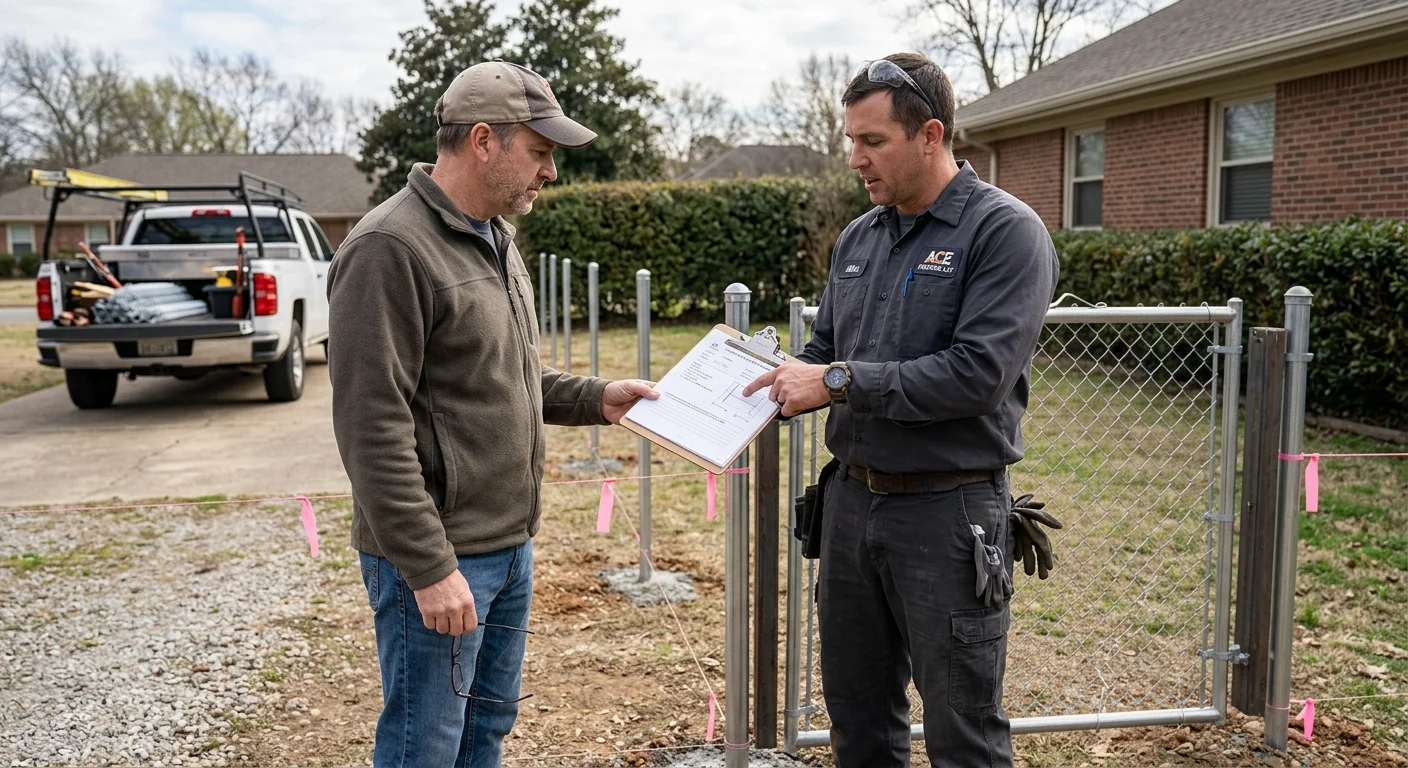
A complete chain link fence installation proposal starts on the ground, not in a catalog. The independent contractor should walk the line with you and write where the run starts, where it turns, and where it stops. Corner, end, and gate posts are terminal posts. Line posts fill the spans between them. If those roles aren’t named, you can’t tell whether two bids cover the same fence.
San Diego lots rarely give a clean rectangle. A Clairemont canyon lot, a Chula Vista alley, and a Poway cul-de-sac each change how a crew reaches the work. The proposal should say how materials get in: street, side yard, rear alley, or over a wall. Tight side yards in Normal Heights or Golden Hill can mean hand-carrying posts and rails. A ranch lot in Ramona or Jamul may need a different access note, including where a truck can stage without chewing the drive. If access isn’t written, two bids aren’t describing the same day of work.
Gate openings need their own measurements. Write the clear opening, not just “a gate.” A walk gate, a double drive gate, and a rolling gate are different assemblies. Hinges, latches, and drop rods belong in that description. A 4-foot walk gate on a Kensington walk street is not the same as a 12-foot drive opening off a Spring Valley cul-de-sac. The proposal should mark which way the leaf swings, and whether it has to clear a slope, a retaining wall, or a parked car. Inside-post-face to inside-post-face is the number that matters for a framed gate. A listed opening that forgets hinge and latch clearance will not match the hardware on delivery.
Property lines belong in writing too. The layout should say whether the fence sits on the surveyed line, inside it, or against an existing wall. Footings that stray onto a neighbor’s lot in North Park or Encanto create a fight later. Ask whether the bid assumes a recent survey, existing markers, or a guess from an old wall. Guessing is not documentation. If the contractor stakes terminal posts in the field, those stakes should match the written plan you keep with the proposal.
Which fabric, posts, rails, fittings, and finish details belong in writing
Chain link is a system. Fabric, posts, rail, fittings, and finish have to match. If a proposal only says “chain link, 4 foot” or “chain link, 6 foot,” it hasn’t specified the fence. That kind of line is a placeholder, not a chain link fence installation scope.
Fabric should name height, mesh size, and wire gauge. Heavier gauge is a thicker wire. The mesh opening matters if kids, dogs, or balls are the reason for the fence. A yard in University City that needs to keep a dog in is not the same spec as a storage yard in Otay Mesa. Don’t let “standard fabric” stand in for those three numbers. If privacy slats might come later, the mesh still has to be named now, because slat stock follows the diamond.
Posts should name terminal posts versus line posts, and the outside diameter of each. Terminal posts carry corners, ends, and gates. They are usually heavier than line posts. The proposal should say whether posts are set in concrete, and it should not hide that choice inside a lump sum. Rails, tension bars, tension bands, rail ends, caps, ties, and a bottom tension wire or hog rod are the fittings that keep fabric from rolling. If those parts aren’t listed, you may be comparing a stretched fence to a draped one.
Finish belongs in the same list. Galvanized steel is the common base. Color coatings and vinyl-coated fabric change both look and how the fence meets salt air. Coastal runs in Ocean Beach, Imperial Beach, and La Jolla see more salt than inland runs in El Cajon or Escondido. A galvanized chain link fence and a coated system are not interchangeable lines on a bid. Ask the contractor to write the finish, not just the color on a sample chip.
California’s C-13 fencing classification authorizes a licensed fencing contractor to construct, erect, alter, or repair fences, posts, flagpoles, and gates. It explicitly excludes masonry walls. If the job ties into a block wall along a South Bay pad or an East County retaining wall, that joint should be described. Masonry work sits outside a C-13 fence-only scope.
How grade changes and existing surfaces shape the installation scope
San Diego County is not a flat slab. Coastal mesas drop into canyons. East County lots step. South Bay pads sit against old walls. Grade is where two professional chain link fence installation bids quietly diverge.
A racked or stepped run follows the slope so the fabric stays close to grade. A level run leaves triangular gaps that dogs and kids use. The proposal should say which method applies on each segment, not just “install on slope.” A hillside in La Mesa or a graded pad in Santee can need both on the same job. If the contractor hasn’t walked the high and low points, the scope is incomplete. Write the change in grade in plain language: where the ground rises, where it falls, and where a corner post has to break the run so the fabric can follow.
Existing surfaces change the work. Concrete driveways, decomposed granite, irrigation mains, and old post holes all sit on typical San Diego property lines. Cutting concrete, core-drilling a mow strip, or working around a stucco wing wall is extra scope. So is removing an old chain link run, pulling footings, or hauling debris. If demolition isn’t listed, assume it isn’t included. A bid that starts at “new fence only” is not a replacement job.
Trees and irrigation deserve their own line. Root flares along alleys in City Heights, and drip lines along backyard fences in Carlsbad, both fight post holes. The proposal should note known conflicts and who is responsible if a line is hit. Utility marking is shared work before anyone digs. Don’t treat it as a footnote. Bottom clearance should be written too. A gap that looks fine on a Clairemont lawn can look like an invitation on a dog run in Vista. Ask how the fabric meets grade on each surface: soil, slope, hardscape, and wall cap.
What to compare when two chain link proposals differ
Line up the two documents and ignore the bottom number until the scopes match. Start with length. If one bid is 140 linear feet and the other is 128, they are not the same fence. Then match height, fabric gauge, mesh, post schedule, finish, gate count, and whether old fence comes out. A chain link fence contractor quote that skips those lines is not cheaper. It is unfinished.
Watch for allowances. “Owner to clear the line” and “includes haul-away” are opposite jobs. “Posts in dirt only” and “includes concrete cutting” are opposite jobs. A lower proposal that skips terminal-post concrete, a bottom wire, or gate drop rods is a different product. Ask each contractor to initial the same checklist: line, fabric, posts, rails, fittings, finish, gates, access, demolition, and grade method.
DIY how-tos make chain link look like a weekend of tools. Stretching fabric, setting terminal posts plumb, and hanging a gate on a slope are the parts that show later. A sagging run on a Mission Valley lot is usually a tension and post problem, not a fabric brand problem. Professional chain link fence installation is the stretching, the terminal assemblies, and the grade, not just unrolling mesh. If one proposal is from a fencing contractor and the other reads like a handyman materials list, treat them as different trades. Confirm a C-13 license on the CSLB license check before you sign.
Chain link also has real limits. It does not hide a yard. It can be climbed. It shows every stored bin and every slope gap. If privacy is the actual goal, slats or another material change the job. Don’t let a thin chain link number win a privacy problem.
Questions about what a 100-foot run costs only make sense after the spec is identical. For how length, height, and gates move a market number, use the chain link fence installation cost guide. This page is about whether two contractors described the same work.
California Business and Professions Code section 7048 exempts some work from contractor licensing when the aggregate contract price for labor, materials, and all other items is less than $1,000, the work is casual, minor, or inconsequential, and it does not require a building permit. The exemption does not apply if the work is part of a larger operation, contracts are split to duck the threshold, the person advertises as a contractor, or the person employs others to do the work. A full yard of professional chain link fence installation is not that kind of job. Hire a licensed fencing contractor for the work you actually need.
Which property and approval questions need outside confirmation
A proposal is not a permit, a survey, or a neighbor agreement. Those sit outside the bid, and San Diego County does not have one rule for every lot.
Inside the City of San Diego, Municipal Code Chapter 14, Article 2, Division 3 (July 2026 publication) Table 142-03A treats fences below 7 feet as not requiring a building permit under that division, and fences 7 feet or greater as Building Permit / Process One. That table is not a pass on zoning, design rules, or coastal overlay amendments. Confirm the current text with Development Services. Required side and rear yards can allow up to 9 feet when the portion above 6 feet is open. A solid fence at a front or street-side property line is generally limited to 3 feet, with setback-based provisions and exceptions. Chain link is an open system, but height and location still have to match the lot’s zone and any coastal overlay. A Del Mar or La Jolla lot is not interchangeable with a Mid-City interior lot.
Unincorporated county land is a different office. County PDS070, revised January 1, 2023, lists a permit exemption for fences and walls no higher than 6 feet if the fence is zoning compliant. The same handout summarizes zoning as 42 inches at the front and exterior side, and 72 inches at the rear and interior side. That applies to unincorporated jurisdiction only. Alpine, parts of Lakeside, Valley Center, and other unincorporated pockets should confirm current applicability with County PDS, not with a city counter. Encinitas, El Cajon, Chula Vista, and Oceanside each run their own counters. Don’t import a City of San Diego table onto a county or other-city lot.
Shared boundary fences sit under Civil Code section 841. Adjoining private landowners are presumed to share equally in reasonable construction, maintenance, or necessary replacement costs unless a written agreement says otherwise. Before you incur those costs, the statute requires 30 days’ advance written notice covering the problem, the proposed solution, estimated costs, the sharing approach, and the timeline. Government lots are excluded. A proposal that assumes the neighbor pays half is not an agreement.
HOA architectural rules in places like 4S Ranch, Carmel Valley, and Scripps Ranch can restrict height, color, and street-facing fabric even when the city or county would allow the fence. Pool barriers are a separate statute. Health and Safety Code section 115923 sets enclosure rules for covered private pools, including a 60-inch minimum height, 2-inch maximum ground clearance, no opening that lets a 4-inch sphere pass, and self-closing, self-latching gates that open away from the pool with the latch at least 60 inches. The exterior should lack child climb features. Don’t treat a backyard chain link run as a pool barrier unless those features are written into the proposal and you’ve confirmed them with the building department.
When to call us
When two chain link proposals don’t match, or the line, gates, and grade still aren’t in writing, stop comparing numbers. Fence Pros San Diego matches you with licensed, independent local fence professionals for chain link and other fence installation work. You contract and pay the contractor directly. Call us at (858) 400-4906 and we’ll connect you with a licensed fence contractor.