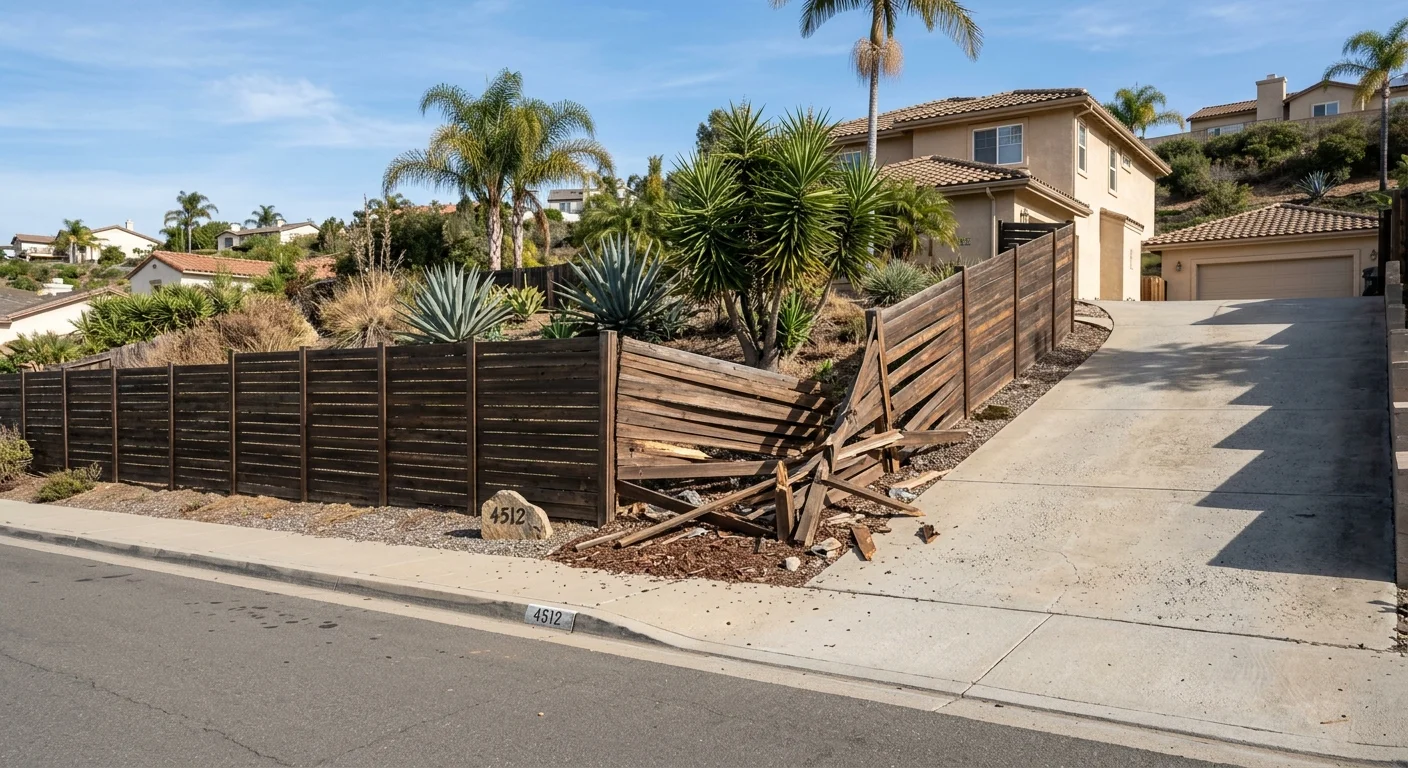
Car hit fence repair in San Diego starts at the wreckage, not in a claim portal. A bumper, a trailer hitch, or a car that rolls out of a driveway can drop a panel into an alley in North Park, a side yard in Chula Vista, or a sidewalk along Mira Mesa Boulevard. Keep people off the broken run, photograph what the vehicle did, and have a licensed fence contractor read the posts before anyone rebuilds.
How to keep people away from the damaged section
A vehicle-damaged fence often leaves boards in the sidewalk, rails across a driveway, or a post leaning toward the street. Treat that run as unstable until a licensed fence contractor says otherwise. The broken bay can still be carrying the next panel.
Keep kids, dogs, and guests off the section. On El Cajon Boulevard, University Avenue, Pacific Highway, and Mira Mesa Boulevard, a rail at shin height is easy to miss. Don’t stand in the travel lane to hold a panel up. If wreckage is in the roadway, that is a traffic problem for law enforcement, not a DIY lift from the curb.
If a gate no longer latches, close that opening with something people can see from a distance. Don’t stack climbable debris against a pool enclosure. For many private single-family pools and spas, California Health and Safety Code section 115923 describes an enclosure at least 60 inches high, with no more than 2 inches of ground clearance, no opening that lets a 4-inch sphere through, and gates that open away from the pool, self-close, and self-latch with the latch at least 60 inches up. The exterior side is not supposed to give a child a foothold. A car that opens that barrier is a different problem than a side-yard privacy hit. Confirm the current rule with the city or county that permitted the pool. The statute has exceptions, and it does not cover every pool type.
On a shared side yard in El Cajon, La Mesa, or Santee, a leaning panel can fall onto a neighbor’s patio. Warn the adjoining household. Don’t shove the wreckage onto their side to free your cars. If the run is blocking the apron, the access problem is the same one in our fallen fence blocking a driveway guide. Storm damage can look similar from the street. A vehicle hit usually concentrates force on one post and the panels tied to it.
If you can work from your own yard, pick up loose boards so they are not trip hazards. Leave posts that are still in the ground. A post that looks only tilted can have a cracked footing. Pulling it can drop the next bay. When the run is open to the street or unsafe at a gate, storm damage and emergency fence repair is the service path. Fence Pros San Diego is a referral service. We match you with licensed, independent fence contractors. We do not own trucks, and we do not do the work.
What to document before requesting a repair assessment
Photos and a short written log matter more than a long recap. Take them before anyone moves the wreckage, unless you have to move a board so people can walk. Fence repair after a car accident often turns on what the first pictures show, not on what people remember a week later.
Shoot the full run from your yard, then from the sidewalk or alley if you can do that without stepping into traffic. Get the damaged posts, the rails, the gate opening, the pavement scuff, and the undamaged panels on both sides. A close shot of a cracked post top does not show whether the next bay is racked. A wide shot does not show a split at the concrete collar. You want both.
If a vehicle is still there, photograph the contact point on the bumper or tire and the matching scar on the fence. Note the date, the street, and the setting: a front yard on a major street, an alley in Golden Hill or City Heights, or a side yard next to a driveway. Those three layouts change how a contractor stages materials later.
Write down what you can see without digging. Which posts moved. Whether the gate still swings. Whether the fence still meets the neighbor’s fence. Whether a masonry wall took the hit. A C-13 fencing license authorizes work to construct, erect, alter, or repair fences, corrals, railings, posts, flagpoles, and gates. It excludes masonry walls. If a block wall took the bumper, say that in the notes so the contractor you’re matched with does not treat it as a wood or vinyl panel job.
Insurers will ask for the same photos. This page cannot tell you whether an auto policy or a homeowner policy will pay, who is at fault, or what a deductible will do. Those answers live in the policy and with the carrier. We could not confirm a specific dollar “rule” for fence repairs, including any $3,000 threshold, in the sources this site is allowed to use. If someone quoted you a number, ask the carrier to show it in writing. Don’t delay photos while you wait on a claim number.
If this is a boundary fence with an adjoining owner, California Civil Code section 841 still sits in the background. Adjoining landowners are presumed to share equally in the reasonable cost of a dividing fence unless a written agreement says otherwise. Before you incur costs you intend to share, the statute requires 30 days’ written notice covering the problem, the proposed fix, estimated costs, the cost-share, and the timeline. A third-party vehicle does not erase that statute, and this page is not legal advice. Confirm with your own counsel or the adjoining owner before you assume they owe half.
Before you sign, check the contractor on the CSLB license lookup.
What a fence pro checks on posts, panels, gates, and footings
The licensed contractor you are matched with will not stop at the broken boards. Vehicle force travels. A hit on one bay can split a rail two posts over, rack a gate, or break the concrete at the collar.
Posts get checked for rotation, lift, and cracks at grade. Coastal yards in Ocean Beach, Pacific Beach, and Imperial Beach often have older wood posts in sandy soil. A hit there can pull a post like a tooth. Inland clay in Escondido, Poway, and El Cajon can hold a post until the collar shears. Same scar from the street, different footing repair. Encinitas salt air and El Cajon heat do not fail a fence the same way, and a vehicle hit lands on whatever was already weak.
Panels fail by material. Wood sheds boards. Vinyl can crack at the routed holes and look fine until the next wind. Chain link stretches and leaves a belly. Steel can bend a picket and torque a weld. The pro should say which bays are structural and which are cosmetic.
Gates need the hinge post, the latch post, and the hardware, not just the swing. A gate that still opens can be out of plumb. A driveway gate that no longer clears the apron becomes a second vehicle problem. If the gate is part of a pool barrier, the self-close and latch height in Health and Safety Code section 115923 are back on the list. Health and Safety Code section 115922 also specifies at least two qualifying safety features for certain permitted new or remodeled private single-family pools and spas, with exceptions and disallowed combinations. That is not a blanket rule for every pool.
Footings are the part you cannot see from the sidewalk. A post can stand and still have a broken bell of concrete below. Repairing the visible panel and leaving a failed footing is how the next car, or the next Santa Ana wind, takes the same bay down.
The pro should also note height and location. In the City of San Diego, Municipal Code Chapter 14, Article 2, Division 3, Table 142-03A treats fences below 7 feet as not needing a building permit under that division, and 7 feet or greater as a Building Permit / Process One item. That is not a free pass on zoning. Section 142.0310 generally keeps a solid fence at the front or street-side line to 3 feet, with setback-based provisions and coastal overlay caveats. Required side and rear yards may go up to 9 feet if the portion above 6 feet is open. In unincorporated county areas, Planning & Development Services handout PDS070, revised January 1, 2023, lists a permit exemption for fences and walls no higher than 6 feet if they are zoning compliant, with a zoning summary of 42 inches at the front and exterior side and 72 inches at the rear and interior side. Confirm the current handout with the County. A like-for-like fence repair at the old height still deserves a permit question if the run sits on a street-side line.
How street, alley, and driveway access changes the repair scope
San Diego County is not one street pattern. Access is half the job, and it is why a car hit in Logan Heights is not the same job as a car hit on a Ramona driveway.
Alley lots in North Park, South Park, Golden Hill, University Heights, and parts of City Heights put the fence a few feet from where people back out. A hit there often takes the alley-side run and dumps debris where trash trucks and neighbors need to pass. Staging lumber in that alley may need a clear path for bins. The contractor cannot assume a long truck will fit.
Street-side fences on Clairemont Drive, El Cajon Boulevard, Pacific Highway, and Mira Mesa Boulevard sit next to moving traffic. Work there may need a different panel delivery and extra care at the property line. Do not assume you can rebuild into the sidewalk or parkway. Confirm the line. If you do not know where it is, that is a survey question, not a guess from the curb.
A broken fence beside a driveway in Chula Vista, National City, or Linda Vista often sits on a short side yard. Even after the panel is “sort of standing,” mirrors can still catch it on the way out. The repair scope includes door swing, gate clearance, and whether a temporary opening is needed so the household can park. Coastal north county streets in Encinitas, Carlsbad, and Solana Beach add tight parking and, on many lots, HOA design rules on top of city height limits. East County lots in Lakeside, Jamul, and Ramona may have longer runs, wider gates, and posts set for trucks. South Bay lots are often narrower, so one hit can affect more of the total fence.
Steep lots in Mission Hills, La Jolla, and Mount Helix add racking. A vehicle that slides downhill into a fence loads the posts on a slope. The replacement may need stepped panels, not a straight run copied from a flat Clairemont yard. Tell the contractor how materials get in: alley, side yard, through the house, or over a wall. That sentence changes labor more than the species of the wood.
When repair and replacement deserve separate proposals
One hit does not automatically mean a full-yard rebuild. It also does not mean a two-board patch is honest.
Ask for the damaged bays as one proposal and any extra replacement as another. Mixing them hides the decision. A post that took the bumper may need replacement. The next three bays may only need rail hardware. If those three bays were already rotten, that is age, not vehicle damage. A licensed pro should say so in writing.
Repair makes sense when the remaining posts are plumb, the footings are intact, and you can match the material. Replacement of the hit run makes sense when the posts rotated, the vinyl cracked down the line, or the gate frame is bent. Full-yard replacement is a separate choice about age, style, and height, not a required outcome of one accident.
Keep the paper trail clean for whoever is paying: vehicle owner, carrier, or you. Separate line items for demolition of the wreckage, post and footing work, panel replacement, gate hardware, and any permit or HOA submittal. Fence Pros San Diego does not set those prices. The contractor you contract with does. We do not quote, discount, or warranty the work.
If the adjoining owner is in the mix under Civil Code 841, a written agreement can override the equal-cost presumption. Get that in writing before the saws come out. If they did not cause the hit, they may not see this as their half. That is a neighbor and legal question. The fence contractor’s job is the fence.
When the hit opened a pool enclosure, treat barrier restoration as its own line. Don’t leave a temporary gap that a child can pass. Don’t assume a hardware-store mesh patch meets Health and Safety Code section 115923.
California Business and Professions Code section 7048 exempts some casual, minor work under $1,000 in the aggregate when a permit is not required, with carve-outs for advertising, employing others, dividing contracts, and work that needs a permit. Vehicle-damaged posts and footings are often not that job. Don’t split a contract to stay under the number. Hire a licensed C-13 contractor for the repair.
When to call us
If a vehicle left a fence unstable, open to the street, or unsafe at a gate or pool opening, you need a licensed fence contractor to assess posts, panels, and footings. Call us at (858) 400-4906 and we’ll connect you with a licensed fence contractor.