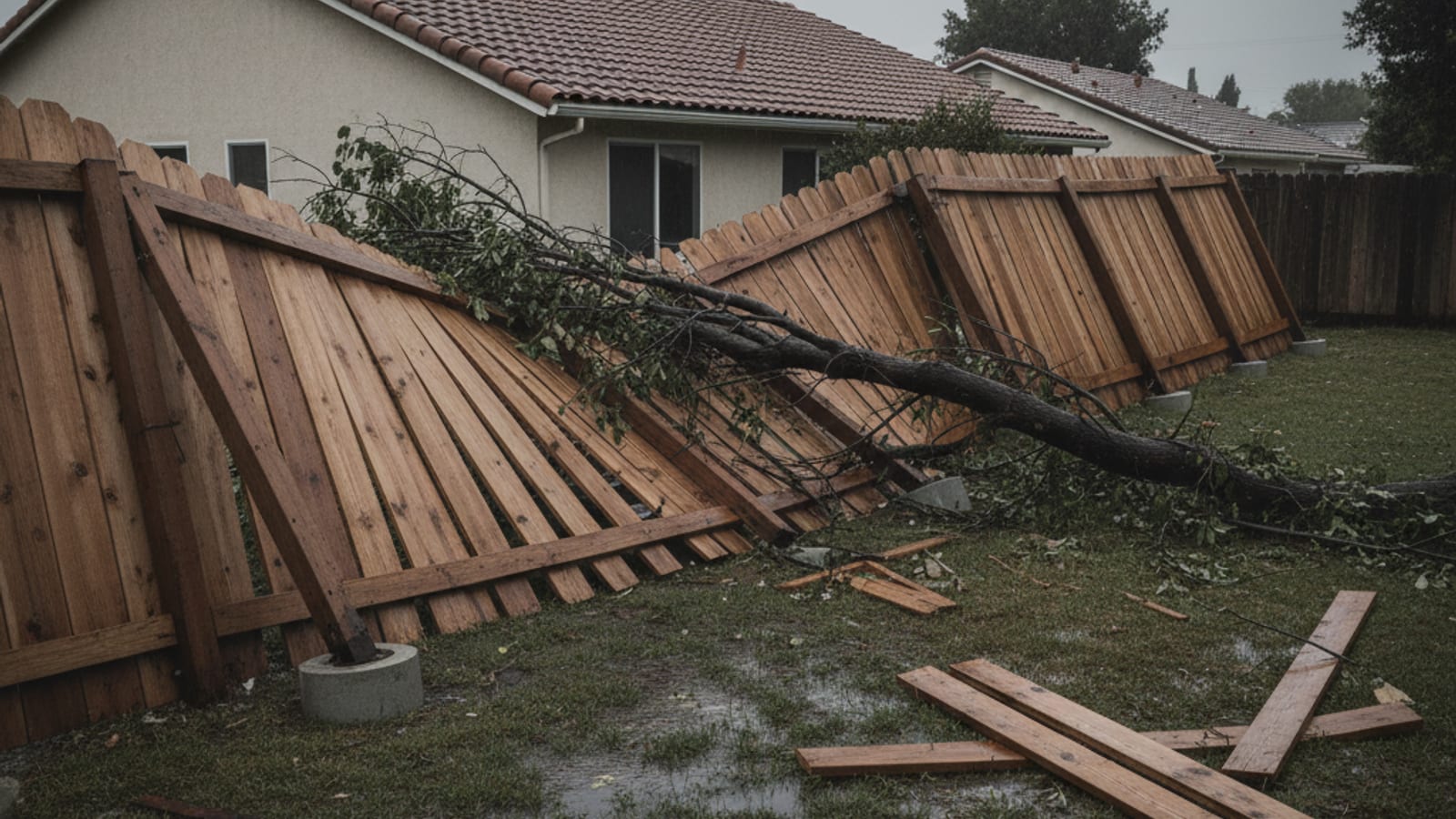
A Santa Ana wind event, winter storm, or fallen tree can take down a long run of fence in a night. Secure the dangerous openings first. Photograph before you move much. Then compare a temporary containment plan with a permanent rebuild quote. Fence Pros San Diego is a referral service. It does not send crews, set prices, or file insurance claims.
If a downed tree or large limb crushed the fence, get the tree work scoped before a rebuild. Emergency tree removal has to happen before posts go back. If you want to harden a fence before the next event, our guide to Santa Ana wind fence preparedness covers the questions to ask.
First hour: check the pool and the street
Two sections deserve attention before the rest of the line.
Pool-area fence. If the fence is an isolation enclosure, California Health and Safety Code section 115923 requires a 60-inch barrier, a small ground gap, no 4-inch-sphere openings, and self-closing, self-latching gates. An opening a child can walk through is a safety problem. Temporary plywood, mesh, or panels are a stopgap until a contractor writes a permanent enclosure repair that still meets 115923. Do not treat Title 24 as the source of those numbers on this page.
Street-facing fence. A downed front run can block a sidewalk, create a visibility problem, or trigger an HOA notice. We could not confirm a countywide HOA grace period from the approved claims ledger. Read your association documents. Ask the city or County whether a temporary street-facing barrier needs any review.
Everything else can wait until daylight, unless wires or a public walkway are involved.
Document damage before moving anything
If you may file an insurance claim, photograph damage before cleanup:
- Wide shots of the full fence line
- Close-ups of broken posts, rails, and hardware
- Tree limbs, tarps, vehicles, or debris that caused the damage
- Shared-line damage on both sides of the boundary
- Timestamped photos (most phones already do this)
If a tree fell from a neighbor’s property, photograph the tree and the fence. That record helps later conversations. It is not a legal opinion.
What’s safe to move yourself
- Loose pickets or broken panels you can lift without lifting posts
- Small branches you can move by hand
- Fence posts that are loose or leaning but still planted: leave them
- Anything with exposed nails: gloves, or leave it
What’s not safe to move
- Large tree limbs that need a chainsaw. Hire a tree service.
- Collapsed sections under power lines. Do not touch. Call SDG&E if wires are involved.
- Posts that snapped into sharp splinters, unless you can handle them safely
- Anything sitting on a neighbor’s property. Wait for a licensed contractor and, if the line is shared, a written neighbor conversation under Civil Code section 841
Temporary containment vs permanent rebuild
Ask the independent contractor to separate two scopes.
Temporary containment might include bracing a leaning post, tarping an opening, or setting a short-term panel on a pool breach. The written note should say how long that setup is intended to last and who is responsible for it.
Permanent rebuild should name posts, rails, boards, gates, hardware, removal, and whether height or location will change. Do not treat a same-height rebuild as automatically permit-free. City of San Diego Table 142-03A still uses 7 feet for that division’s building-permit split. Unincorporated County PDS 070 excepts qualifying fences not over 6 feet that also meet zoning. Pool enclosure geometry still has to meet 115923 if the fence is an isolation barrier.
Fence Pros San Diego does not prioritize storm calls, dispatch crews, or promise a first-visit clock. Emergency fence and fence repair pages can connect you with a licensed independent contractor. That contractor sets the schedule.
What belongs in a rebuild proposal
Ask for:
- Starting and ending points of the damaged run
- Which posts stay, get reset, or get replaced
- Hardware grade, especially on coastal lots
- Whether post depth and diameter are specified in inches for this soil
- Permit responsibility, if any
- How insurance documentation will be delivered, if you asked for it
County PDS 070 lists wood-post footing notes as recommendations only, including a 12-inch-diameter concrete note and about 24 inches into undisturbed ground or compacted fill. That is not a citywide rebuild recipe and not a reason to publish a 30- to 36-inch “upgrade.” Ask the bidder for the inches they will use at this address.
Do not assume insurance covers the work. Coverage, deductibles, “other structures” limits, and neighbor-tree liability are policy questions. Ask your carrier. Ask the contractor for a line-item scope and license number. Fence Pros San Diego does not file claims or interpret policies.
Upgrading during the rebuild
A rebuild is a chance to name weak spots in writing:
- Posts that failed at the base
- Zinc-plated hardware on a coastal or wind-loaded run
- A pool gate that no longer self-closes
- A street-facing height that never matched zoning
Each upgrade is optional. Price it as its own line, not as if it were required by this page. Fence post repair is the referral path when the base is the issue.
Frequently asked questions
Does homeowner’s insurance cover storm fence damage in San Diego?
That depends on the policy and the event. Sudden storm damage and gradual rot are different conversations. Ask your carrier what the policy covers. A contractor can write a scope. Fence Pros San Diego does not.
How much does storm fence repair cost in San Diego?
Fence Pros San Diego does not set contractor prices. Compare itemized proposals for the same measured run. Separate temporary containment from permanent rebuild.
How quickly can a storm-damaged fence be repaired?
No verified countywide clock is in the approved claims ledger. Stock, access, permits, pool-enclosure rules, and the contractor’s own book all change the date. Ask for a written schedule from the person doing the work.
Who pays if a neighbor’s tree knocked down my fence?
That is a fact-specific legal and insurance question. Photograph both the tree and the fence. Civil Code 841 may matter if the fence is a shared boundary. It does not decide tree-liability by itself.
Do I need a permit to replace a storm-damaged fence in San Diego?
Like-for-like repair at the same height and line often stays off the building-permit desk, but that is not a countywide letter. City Table 142-03A still triggers a building permit at 7 feet and up. County PDS 070 excepts qualifying fences not over 6 feet. Raising height, moving the line, or repairing a pool enclosure can change the answer. Confirm with the desk that owns the address. Permit guide.
Can fence damage from salt air and coastal weather be claimed on insurance?
Gradual corrosion and rot are usually treated as maintenance, not a single storm event. Ask the carrier. For coastal hardware questions, see salt air and coastal fence hardware.
When to call us
Call when a downed post, pool-barrier opening, or street-facing collapse needs a licensed fence professional. Have photos, the address, and whether a pool or shared line is involved.
Call us at (858) 400-4906 and we’ll connect you with a licensed fence contractor.