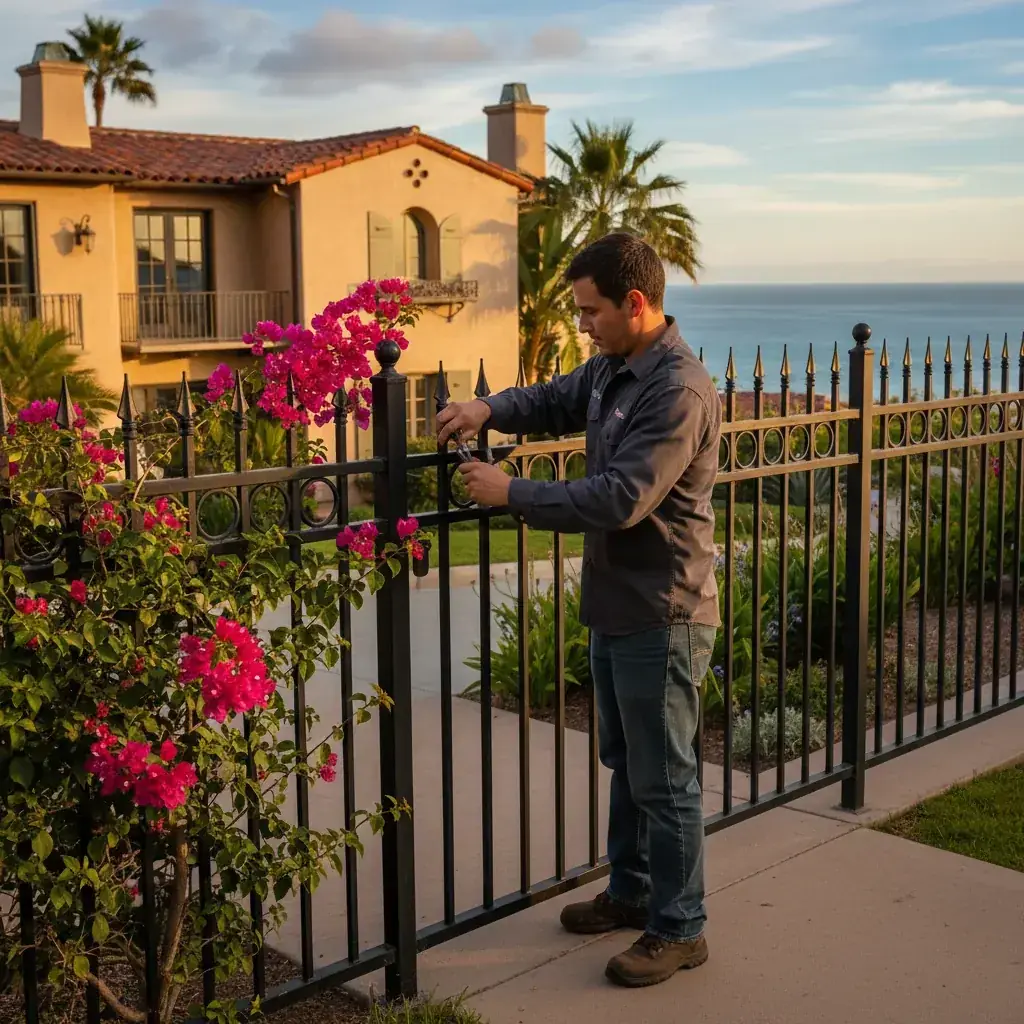
A professionally installed wrought iron fence in San Diego typically costs $95 to $225 per linear foot, depending on height, design complexity, and finish quality. What most homeowners call “wrought iron” is actually fabricated ornamental steel, which is stronger, more consistent, and better suited for powder-coat finishes that resist the coastal salt air. The biggest factors driving longevity here are galvanized steel, properly cleaned welds, and a quality powder-coat finish. Without those three, rust wins within a few years on a coastal property.
Real wrought iron vs welded steel: what San Diego installers actually use
Let’s clear up the biggest misconception right away. When you see a beautiful, black “wrought iron fence” today, you’re almost certainly looking at a fence made of ornamental steel.
True wrought iron is a specific iron alloy with a very low carbon content, which was traditionally heated and hammered into shape by a blacksmith. This process gives it a distinct, fibrous texture. It’s also incredibly labor-intensive, making it prohibitively expensive and rare for modern fencing projects.
So, what are companies like ours actually installing? We use high-quality, fabricated steel. This isn’t a downgrade; it’s an upgrade in nearly every practical way:
- Strength & Durability: Modern steel is stronger and more consistent than traditional wrought iron, providing better security.
- Cost-Effectiveness: Steel is far more affordable to source and fabricate, making elegant designs accessible to more homeowners.
- Precision: Steel can be precisely cut and welded, allowing for a huge range of clean, consistent designs, from simple modern panels to intricate, classic patterns.
- Finishes: Steel is the perfect substrate for modern protective finishes like galvanization and powder coating, which are essential for longevity in our climate.
When you search for wrought iron fence panels, you’ll find options made from tubular or solid steel. For most residential applications, heavy-gauge tubular steel offers the best balance of strength, weight, and cost. When a contractor talks about an “iron fence,” they are using the common term for what is technically a welded steel fence. It delivers the classic aesthetic you want with the performance you need.
Coastal rust: what fails first and how good crews prevent it
Here in San Diego County, our biggest enemy isn’t intruders; it’s the salty marine layer. The salt in the air is highly corrosive and will attack any unprotected ferrous metal. For an iron fence, this means rust is not a matter of if, but when and how badly.
Rust always starts at the weakest points. These are:
- Welds: The high heat of welding burns off any protective coating on the steel. If not properly cleaned and re-coated, the weld joint is the first place you’ll see rust bloom.
- Scratches and Dings: Any nick in the paint or powder coat exposes the raw steel underneath to moisture and salt.
- Hollow Posts & Rails: Cheaply made fence panels can trap moisture inside the hollow tubes with no way for it to escape, causing them to rust from the inside out.
- Hardware: Using the wrong bolts, screws, or fasteners can create a point of galvanic corrosion where two dissimilar metals meet.
A professional fence crew prevents these issues before the first post ever goes in the ground. Our process focuses on a multi-layered defense:
- Material Selection: We start with pre-galvanized steel. This means the steel has a protective zinc coating applied at the mill, providing a base layer of rust resistance even before fabrication.
- Quality Fabrication: All welds are meticulously cleaned and ground smooth. This removes impurities and creates a perfect surface for the finish to adhere to. We also ensure posts have weep holes or are properly capped to prevent internal water collection.
- Powder Coating: This is the single most important step for coastal longevity. Unlike spray paint, powder coating is a dry powder that is applied electrostatically and then cured under high heat. It fuses to the metal, creating a thick, durable, and uniform shell that is far more resistant to chipping, scratching, and UV damage.
- Proper Hardware: We exclusively use high-quality, coated or stainless steel hardware. As we discuss in our guide to coastal fence hardware, using the right fasteners is non-negotiable near the ocean.
Spanish, Mediterranean, and modern style options
One of the greatest advantages of a steel fence is its design versatility. It can be fabricated to perfectly match the architectural style of your home, whether it’s a classic Spanish Revival in Coronado or a sleek, modern build in Cardiff.
Spanish & Mediterranean Styles
These are the quintessential looks for many of San Diego’s most beautiful neighborhoods. They are characterized by ornamental details and classic motifs that add a touch of old-world elegance.
- Finials: Decorative tops for the vertical pickets, such as spears, fleurs-de-lis, or tri-ad points.
- Scrollwork: Curving, S-shaped or C-shaped elements that can be incorporated into panels or gates for a more elaborate look.
- Rings & Knuckles: Cast iron decorative elements that can be added to pickets for texture and visual interest.
- Arched Tops: Fence panels and gates can be built with a graceful upward curve, softening the lines and creating a grander entrance.
Modern & Contemporary Styles
For homes with a more minimalist aesthetic, an iron fence can provide clean lines and a strong geometric presence without feeling heavy or dated.
- Horizontal Rails: Instead of vertical pickets, long horizontal steel tubes create a sleek, linear look.
- Flat Tops: Panels have a simple, flat top rail with no decorative finials for a clean, unobtrusive profile.
- Negative Space: Modern designs often play with the spacing between pickets, using wider gaps to create a sense of openness while still defining the property line.
- Matte Finishes: A matte black or charcoal gray powder coat finish is a popular choice for contemporary homes, offering a sophisticated, non-reflective surface.
Whether you’re looking for pre-fabricated wrought iron fence panels for a straightforward project or a fully custom design, the options are nearly limitless.
Cost per linear foot for residential iron fencing
The cost of an iron fence in San Diego can vary significantly based on several factors, but a realistic budget for a professionally installed project is typically between $95 and $225 per linear foot.
Here’s what drives that price range:
- Height & Gauge: A standard 4-foot-tall fence will cost less than a 6-foot security fence. Likewise, a fence made with heavier-gauge, thicker-walled steel will be more expensive than one with lighter materials.
- Complexity of Design: A simple, flat-top fence with vertical pickets is on the lower end of the cost spectrum. Adding scrollwork, decorative finials, rings, or custom plasma-cut designs will increase labor and material costs.
- Finish: Powder coating is more expensive upfront than a basic primed and painted finish, but its vastly superior lifespan makes it a much better long-term investment, especially near the coast.
- Site Conditions: Installing a fence on a steep slope, through hard soil or rock, or in an area with difficult access will increase the labor time and overall cost. Demolition and hauling away an old fence will also add to the project total.
- Gates: The cost of gates is calculated separately from the per-foot price of the fence panels. A simple pedestrian gate might add a few hundred dollars, while a large, automated driveway gate can add several thousand.
When getting estimates for your fence installation, make sure the quote clearly specifies the material gauge, finish type, and hardware being used. A cheaper quote often means corners are being cut on one of these critical components.
Pairing iron with stucco walls, hedges, and gates
An iron fence rarely stands alone. Its beauty is often magnified when integrated thoughtfully with other landscape and architectural elements.
Iron on Stucco or Masonry Walls
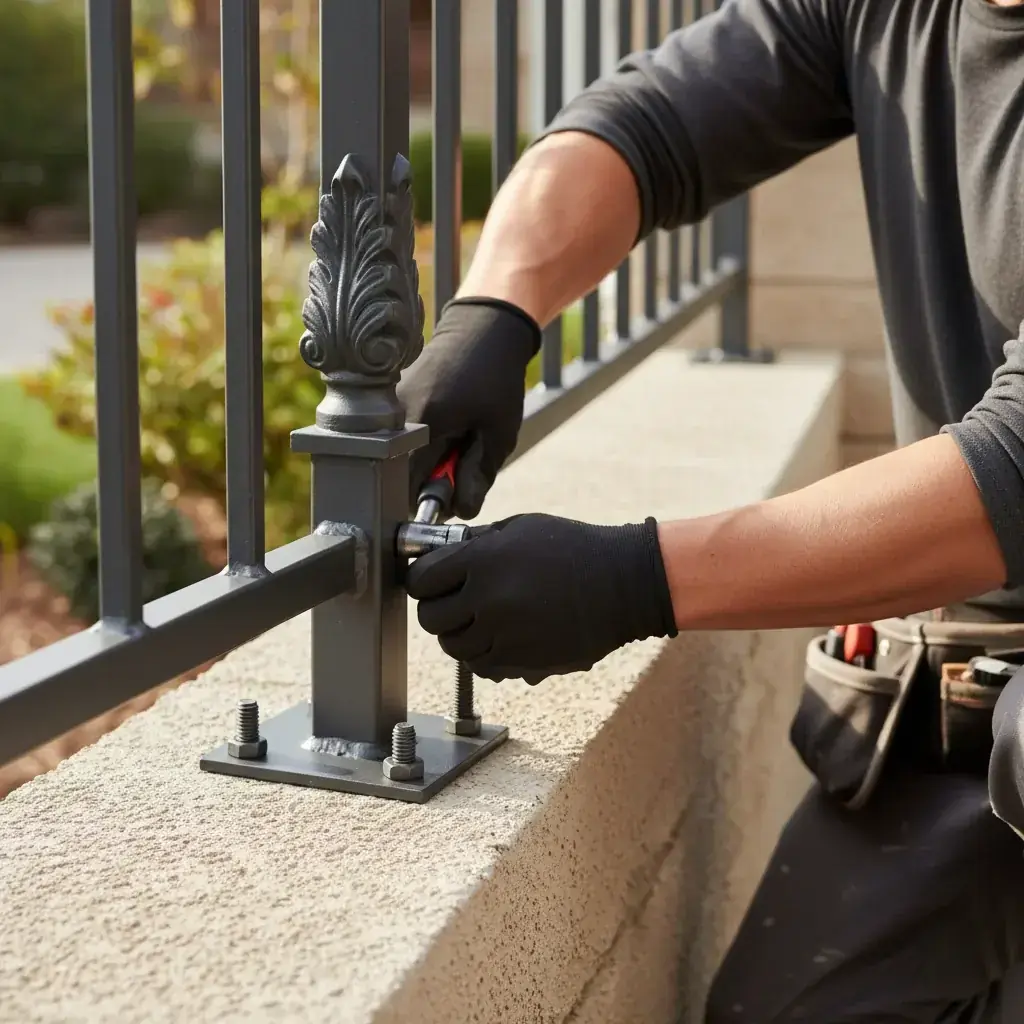
A very popular look throughout San Diego is a low stucco or concrete block wall topped with an iron fence. This “pony wall” combination provides a solid base for privacy and security at ground level while the open ironwork above preserves views and a sense of space. Proper installation is key here. Posts must be core-drilled and set with hydraulic cement, and the base plates must be sealed to prevent water from seeping into the wall and causing cracking or spalling.
Iron with Hedges and Landscaping
Iron fencing acts as the perfect formal frame for landscaping. It can be installed in front of a dense ficus or podocarpus hedge to provide a layer of security while the hedge grows in for complete privacy. The dark color of the fence recedes into the background, letting the green of your plants take center stage. It also serves as a durable trellis for climbing plants like bougainvillea or star jasmine, which can soften the look and add color.
Matching Gates
Your fence and gate should feel like a single, cohesive system. We can fabricate gates that perfectly match the style of your fence panels, from a simple walkway gate to a grand automated driveway gate. A well-designed gate not only secures your property but also acts as the official welcoming point for your home. When considering a driveway gate, be sure to plan for automation, as a professionally integrated system adds convenience and value. Our gate installation team can design and install a wide variety of swing and slide gate operators to fit your needs.
Frequently asked questions
How much does a wrought iron fence cost per foot in San Diego?
Most residential wrought iron (ornamental steel) fencing in San Diego runs $95 to $225 per linear foot installed. A standard 4-foot flat-top panel with basic powder coating sits near the lower end, while 6-foot panels with scrollwork, decorative finials, and a premium coastal-grade finish push toward the higher end. Gates are priced separately and can add several hundred to several thousand dollars depending on size and automation.
How do I stop an iron fence from rusting in coastal San Diego?
The best defense is a multi-layer system: start with pre-galvanized steel, grind and clean all welds before finishing, then apply a full powder-coat rather than spray paint. Powder coating fuses to the metal under high heat and holds up far better against salt air than brushed or sprayed finishes. You’ll also want to touch up any chips or scratches quickly with a rust-inhibiting primer, since even a small nick in the coating is enough for salt to get under the surface.
How long does an iron fence last in San Diego?
A properly installed and powder-coated ornamental steel fence in San Diego should last 20 to 40 years with minimal maintenance. Properties within a mile of the coast should expect to inspect the fence annually and touch up any finish damage. Fences installed with galvanized steel and quality powder coating consistently outlast those done with paint-only finishes by 10 or more years.
Do I need a permit to install a wrought iron fence in San Diego?
Most residential fences under 6 feet tall in San Diego do not require a building permit, but that depends on your city, HOA rules, and whether the fence runs along a public right-of-way. Some coastal zones and historic districts have additional restrictions. Your installer should pull any required permits before work begins. For a fence installation that includes a masonry wall or automated gate, permits are more commonly required.
What’s the difference between wrought iron fence panels and custom-fabricated iron?
Pre-fabricated wrought iron fence panels are manufactured in standard lengths and heights, then cut and welded on-site. They’re faster to install and cost less. Custom-fabricated fencing is built to your exact dimensions, design, and finish spec in a shop or on-site, which makes sense for non-standard lot shapes, elaborate Spanish or Mediterranean scrollwork, or when you need to match an existing gate or wall detail closely. Most San Diego homeowners with straightforward lots get excellent results from pre-fabricated panels.
Is ornamental steel better than aluminum for San Diego coastal homes?
Ornamental steel is heavier, stronger, and holds up better to impact and bending, which matters for security fencing and gate installation with automated operators. Aluminum won’t rust at all, which makes it appealing near the ocean, but it’s softer and more prone to denting. For coastal properties where aesthetics and security are both priorities, steel with a proper powder-coat finish is generally the better call.
When to call us
While some home projects are suitable for a DIY approach, installing a steel fence for long-term performance is a job for a professional. Proper footing, precise alignment, quality welding, and especially the right protective coatings are essential to getting a fence that lasts for decades instead of rusting out in a few years. Ensure any contractor you hire is licensed and insured, you can check their status on the CSLB website.
If you’re ready to add the timeless security and elegance of an iron fence to your San Diego property, we’re here to help.
Call us at (858) 925-5546 for a same-day estimate.