The listing moment turns a leaning fence into a decision, not a someday chore. Buyers see the line from the curb, in photos, and on the walk to the backyard. Fence repair before selling home starts with a full-line record, then a licensed contractor’s split between work that holds the fence up and work that only changes how it looks.
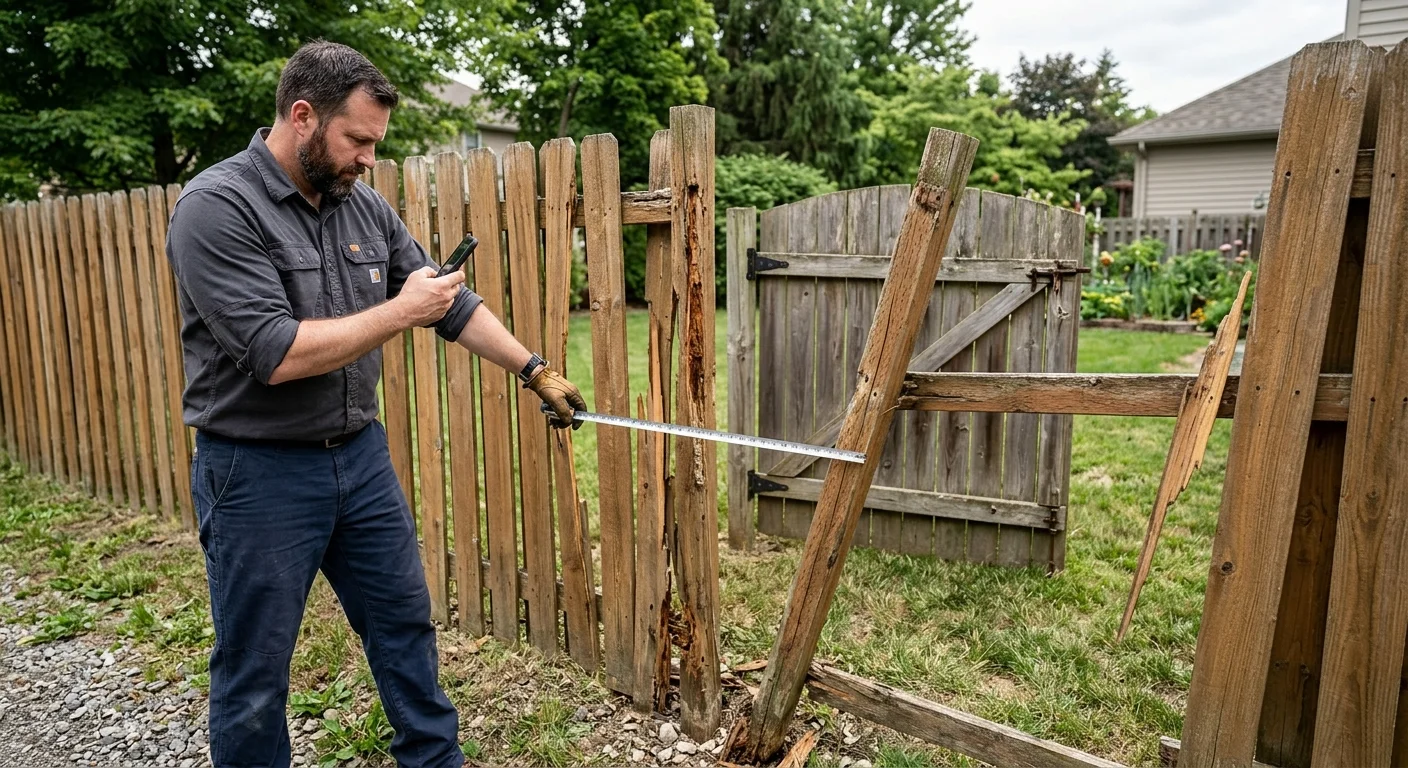
How to document visible damage across the full fence line
Start at the sidewalk, not the back gate. In San Diego County, listing photos catch the street-side run first. Walk every bay, both sides, in daylight. A Coronado picket line and an El Cajon privacy run fail differently. The mapping method does not.
Number the bays as you go. Call the front corner Post 1, then move clockwise. Photograph each bay straight on, then at the soil line, then the neighbor-facing side if you can do that without stepping onto their lot. Add one wide shot of each run so a contractor can see lean across a stretch.
Write what you see in plain notes. Leaning. Split rail. Missing picket. Gate scrapes the slab. Hardware frozen. Don’t diagnose cause. That is the contractor’s job. Your job is a complete map.
Walk the line after irrigation runs. Overspray at post bases is common in Clairemont, Mission Valley, and inland tracts where clay holds water. Coastal lots in Ocean Beach, Imperial Beach, and Encinitas need a hardware pass. Salt air seizes latches before the boards look spent.
Don’t skip what photos crop out. Alley gates in North Park. Canyon-edge runs in Tierrasanta. Stepped downhill faces in La Mesa. Shared-line boards in National City and Chula Vista.
If you don’t know whether the fence sits on the property line, write that down. California Civil Code §841 treats adjoining private landowners as sharing the reasonable costs of a dividing fence unless a written agreement says otherwise. Before anyone incurs those costs, the statute requires 30 days’ written notice describing the problem, the proposed work, estimated costs, a cost-sharing approach, and a timeline. Government lots are excluded. Confirm the current text with California Legislative Information.
If the structure is a masonry wall, flag it. A California C-13 fencing license covers fences, gates, and posts. It excludes masonry walls.
What posts, panels, rails, and gates need closer assessment
A listing walk-through treats the fence as one object. A contractor has to split it. Posts, panels, rails, and gates fail on different clocks, especially on one lot with a street face, a side yard, and a downhill rear.
Posts are the load path. Sight a lean against a house wall or the neighboring run. Push the post gently at chest height. Movement at grade matters more than a weathered top. Check the soil collar for rot on wood, rust scale on steel, and cracked or hollow-sounding concrete. Inland heat and irrigation in Escondido, Santee, and Lakeside cook the base. Coastal wind and salt work the same joint from the other direction.
Rails tell you whether the frame is still a frame. A split rail, a rail pulled off the post, or fasteners that have walked out means the panels are hanging on habit. On vinyl, look for racks: panels that have shifted so the top rail is no longer level. On chain link, look for a drooping top rail and loose tension bands.
Panels are what buyers photograph. Missing boards, kicked-out pickets, and holes at dog height are function problems if they open the yard. Gray or sun-bleached faces are appearance unless the wood is soft. Vinyl color shift on a south or west run in East County is common. It is not the same as a cracked post or a separated panel lock.
Gates get used at every showing. A gate that will not latch, drags, or swings into the yard is a function item. Check hinges, the latch, the stop, and whether the gate post has rotated. If the property has a pool, treat the pool barrier as its own list. California Health and Safety Code §115923 sets enclosure rules for covered private single-family pools and spas, including a 60-inch minimum height, a 2-inch maximum ground clearance, no opening that lets a 4-inch sphere through, and gates that open away from the pool with a self-closing, self-latching device at least 60 inches high. That is not a blanket rule for every backyard fence. Confirm whether your pool type is covered.
Have an independent licensed fence contractor do this assessment. Fence Pros San Diego is a referral service. We match you with licensed local fence pros. We don’t inspect the line ourselves.
How to separate functional repairs from appearance requests
This is the cut that keeps a listing job from turning into a rebuild you didn’t ask for. Functional work restores a fence that stands, closes, and contains. Appearance work changes color, style, or how new it looks. Both can be legitimate. They should not share one unlabeled line item.
Functional work includes posts that move, rails that have failed, holes a pet or child can use, a gate that will not latch, and a run that has left the property line. Those items show up in photos and on a walk. They are the core of fence repair for a home seller, not a style upgrade.
Appearance work includes stain color, a wish to match a neighbor’s new vinyl, swapping a sound chain-link run for privacy boards, and replacing boards that are gray but still sound. Buyers often have their own taste. Spending on a look they will change is a judgment call for you and your agent. It is not a fence-code requirement.
What not to treat as required fence work: a full restain because the wood is weathered, a material upgrade because a nearby house just rebuilt, decorative toppers, or rebuilding a straight, latched run that simply looks old. Those may still be worth doing. They belong on a separate request list so contractors don’t bury them inside structural scope.
Height and street-face rules are a third bucket. They are not appearance, and they are not always repair. Inside the City of San Diego, Municipal Code Chapter 14, Article 2, Division 3, Table 142-03A lists fences below 7 feet as needing no permit under that division, and fences 7 feet or greater as needing a Building Permit (Process One). That exemption is not the same as zoning compliance. Required side and rear yards may allow up to 9 feet when the portion above 6 feet is open. A solid fence at the front or street-side property line is generally limited to 3 feet, with setback-based provisions and exceptions. Coastal overlay lots need extra checks. Read the current division in the City of San Diego municipal code.
Unincorporated county lots are a different jurisdiction. County PDS070, revised 2023-01-01, lists a permit exemption for fences and walls no higher than 6 feet if they are zoning compliant, and summarizes 42 inches at the front and exterior side and 72 inches at the rear and interior side. Confirm current applicability with the County. Don’t import city numbers onto a Ramona, Jamul, or unincorporated Lakeside lot.
Questions about sale price, credits, or what a seller must fix before closing are real estate questions. A fence contractor can document condition. Your agent and the purchase contract address the rest. If you also want the marketability discussion, that lives on does a fence increase home value in San Diego. This page stays on repair scope.
When repair and replacement deserve separate proposals
Ask for two written scopes when the line is mixed. One scope repairs named bays. The other replaces named runs. A single “fix the fence” bid hides the fork.
Repair is the right proposal when the posts are sound, the damage is clustered, and matching material is still available. Replacement belongs on its own page when posts have failed in a row, when mixed patches would leave a zipper of old and new, or when height or material will change. That last case is closer to fence installation than to a patch.
Don’t use a round percentage as a rule. Some contractors talk that way. It is not a California standard, and it is not a figure we can verify. The honest split is bay by bay: this post stays, this post goes, this run is a new line.
Wood makes that split messy. Sun, irrigation, and termites don’t age every board together. Use a licensed C-13 contractor to say which posts still carry load. Our wood fence repair vs replacement guide is the longer version of that call. Vinyl with a cracked post or separated panels, and chain link with a failed top rail, need the same component-level split.
If work is more than casual patching, licensing matters. California Business and Professions Code §7048 exempts some work under $1,000 in aggregate for labor, materials, and other items, when the work is casual, minor, or inconsequential and does not need a building permit. The exemption does not apply if contracts are split to stay under the threshold, if the person advertises as a contractor, or if they employ others to do the work. A listing repair that needs a permit, or that is part of a larger fence job, should be performed by a licensed contractor. Verify any license on the CSLB license check.
Keep neighbor work on the shared-line proposal, not mixed into street-face patching. Shared cost and notice sit on Civil Code §841. Street-face height sits on the city or county rules above. Mixing those in one lump sum makes the scopes impossible to compare.
What records help compare contractor scopes before listing
You’re comparing scopes, not vibes. Ask each licensed contractor for the same packet so the differences are real.
Need, in writing:
- Address and which runs they walked
- Bay-by-bay notes that match your photos
- Posts, rails, panels, and gates on separate lines
- Function work separated from appearance requests
- Repair scope and replacement scope as two options where the line is mixed
- Whether the fence is treated as shared, and whether §841 notice is still outstanding
- Whether they believe a permit applies, with the city or county named
- Their CSLB license number
Attach your photo set to every request. Same photos, same numbers. If one proposal says replace a long run and another says replace three posts and eight boards, you need the bay map to see whether they walked the same fence.
Don’t pick on a single total. Totals hide whether stain, haul-off, gate hardware, and post footings are in or out. Line items are the comparison. Fence Pros San Diego does not set prices. The contractor you contract with does.
Keep a copy of any neighbor notice, any survey, and any city or county note about height. Those records travel with the listing file. They also stop a second contractor from re-arguing a line the first one already measured.
If two scopes still don’t match, ask both contractors to mark your photo map. Circles on Post 6 and Bay 9 are clearer than another paragraph. That is how you repair a fence before listing a house without paying twice for the same bay, or missing the damaged fence a home sale walk-through will catch from the alley.
When to call us
A mixed fence line before a listing is licensed C-13 work, not a weekend guess, once posts move, gates fail, or a run needs to come down. Call us at (858) 400-4906 and we’ll connect you with a licensed fence contractor. You contract with that pro directly.