TL;DR
- California’s Swimming Pool Safety Act is Health and Safety Code sections 115920 and following. The two sections that decide most fence conversations are 115922 and 115923.
- When a building permit is issued for a new private single-family pool or spa, or for remodeling one, 115922 requires at least two of seven drowning-prevention features. Some pairs do not count.
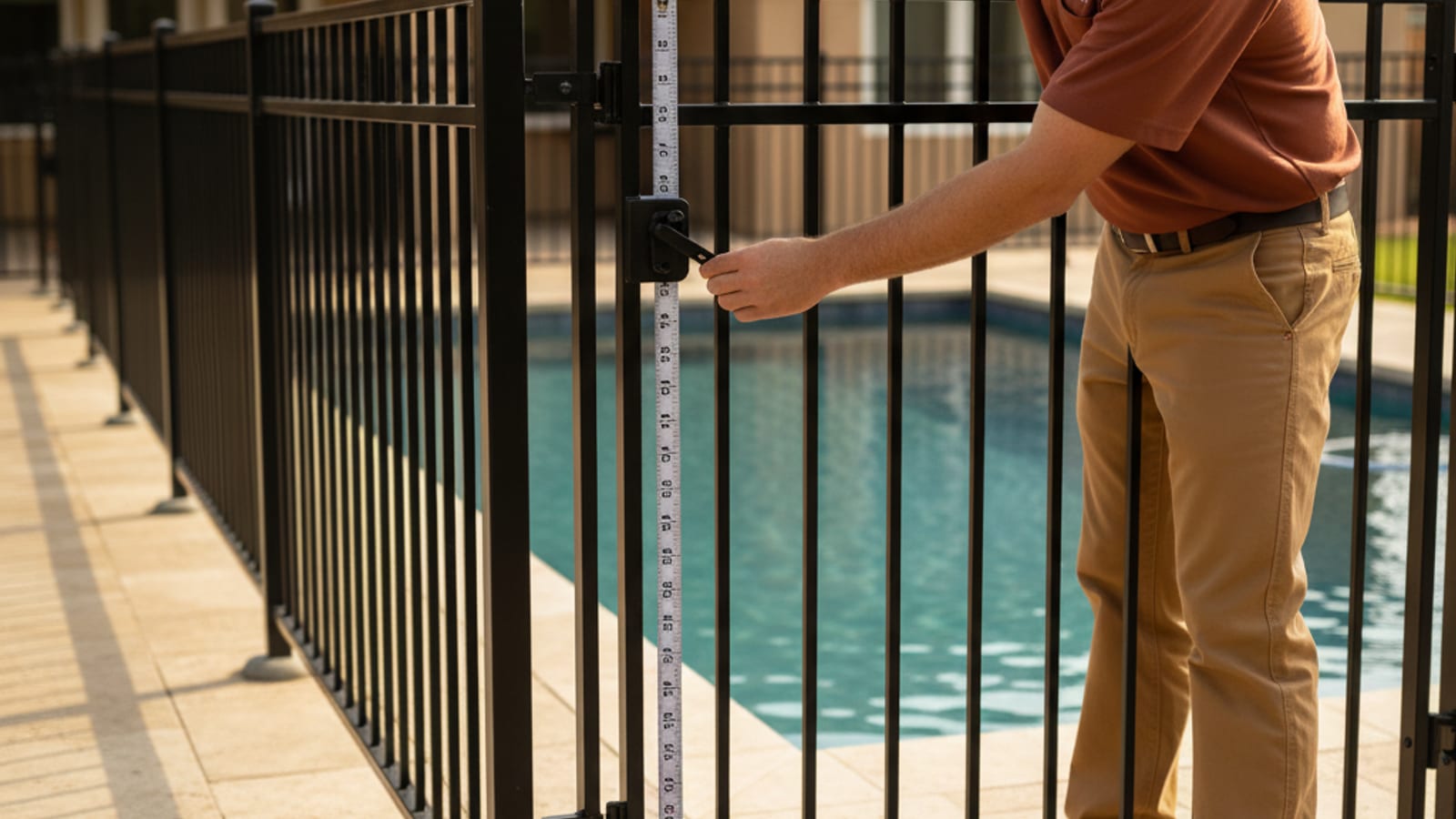
- If you use an enclosure as one of those features, 115923 is the physical checklist: 60-inch minimum height, 2-inch maximum bottom clearance, no 4-inch-sphere gaps, gates that swing away from the pool and self-close, latch no lower than 60 inches, no climbable outside face for a child under five.
- A 54-inch latch is the house-door device in 115922(a)(5), not the enclosure-gate latch.
- Cities still inspect under the building code they have adopted. This page reprints the saved statute text, not a Title 24 guess.
California pool barrier rules show up at permit, at final inspection, and later when a buyer or an insurer asks whether the water is isolated. They apply on top of ordinary fence permit and fence law questions. Fence Pros San Diego is a referral line. We do not inspect pools, we do not certify compliance, and we do not sell “free listing inspections.” An independent contractor or the building department answers whether your built line matches the statute.
The current 115922 text in the job file is the version amended by Stats. 2024, Ch. 769 (SB 552), effective January 1, 2025. Confirm you are reading the same section the inspector is using.
What section 115922 actually requires
This is not “every old pool in California must have a 60-inch fence tomorrow” in the words of 115922. The trigger in (a) is: a building permit for construction of a new swimming pool or spa, or remodeling of an existing one, at a private single-family home (with the exceptions and cross-references the statute names).
When that trigger hits, the pool or spa must have at least two of the following seven features:
- An enclosure that meets 115923 and isolates the swimming pool or spa from the private single-family home.
- Removable mesh fencing that meets ASTM F2286, with a gate that is self-closing and self-latching and can accommodate a key lockable device.
- A manually operated or power-operated safety pool cover with a label verifying ASTM F1346-23.
- Exit alarms on the home’s doors and windows that provide direct access to the pool or spa without an intervening enclosure. When a door or window is opened or left ajar, the alarm must make a continuous audible sound or a repeating verbal warning (the statute’s example is a notice that “the door to the pool is open”). Battery or hard-wired is allowed.
- A self-closing, self-latching device with a release no lower than 54 inches above the floor on the home’s doors that provide direct access to the pool or spa.
- An in-water alarm, in good repair, independently certified to ASTM F2208 (surface motion, pressure, sonar, laser, infrared). A wearable alarm on a child, or an alarm that only sounds when the child wanders, is not a qualifying feature.
- Other means of protection independently verified by an approved testing laboratory as meeting ASTM, ASME, or another nationally recognized standard, with a label.
Pairs that do not satisfy 115922(b):
- An exit alarm and a self-closing, self-latching device on the same door.
- An exit alarm and a door latch on separate doors.
- A safety pool cover and an in-pool alarm described in (a)(6).
Before final approval of the permitted work, the local building official inspects the required features. That is 115922(c).
A glass, aluminum, wood, or mesh fence is only “feature 1” if it is a 115923 enclosure and it isolates the water from the house. A pretty barrier that leaves a wide open path from the slider to the water is not that feature.
What section 115923 requires of an enclosure
An enclosure must have all of the following:
(a) Access gates open away from the swimming pool, and are self-closing with a self-latching device placed no lower than 60 inches above the ground.
(b) A minimum height of 60 inches.
(c) A maximum vertical clearance from the ground to the bottom of the enclosure of two inches.
(d) Gaps or voids, if any, do not allow passage of a sphere equal to or greater than four inches in diameter.
(e) An outside surface free of protrusions, cavities, or other physical characteristics that would serve as handholds or footholds that could enable a child below the age of five years to climb over.
That is the whole enclosure list in the saved statute. It does not recite a 45-inch horizontal-rail measurement, a 1.75-inch chain-link mesh size, or a “push-button latch is illegal” sentence. Building departments may still apply adopted pool-barrier code with extra climbability or mesh tests. Ask the city for the checklist they use at inspection. Do not treat a blog’s extra inches as 115923.
Where existing fences usually fail those tests
These are field failures that map to 115923, not to a network war story.
Latch too low. A residential gate latch at belt height is not a 60-inch enclosure latch. Toddlers can reach it. 54 inches is the interior door device in 115922, not a pool-gate discount.
Gate does not self-close or self-latch. Worn gravity hinges, a leaf that drags, or a latch that needs a hip-check. Inspectors open the gate and let it go. It has to finish closed and latched.
Gate swings toward the water. 115923(a) says access gates open away from the swimming pool.
More than 2 inches under the fence. Common on heaved grade and old stepped lawns. 115923(c) is two inches, not four. Four inches is the sphere test for gaps in the barrier, 115923(d). Mixing those two numbers is how homeowners “fix” the wrong plane.
Climbable outside face. Decorative grids, low horizontal rails, hot tub steps, and stacked stone against the fence can be footholds for a child under five even when picket spacing is tight.
Isolation failure. A 60-inch side-yard fence that still leaves the kitchen slider as open access to the water is not 115922 feature 1.
Materials: what can meet 115923, not what it “costs”
Ornamental aluminum, glass, wood privacy, vinyl, chain link, and removable mesh can all be built as enclosures if the finished geometry matches 115923. Mesh used as 115922 feature 2 has its own ASTM F2286 plus lockable-gate rule. Do not assume a hardware-store roll-up is that product.
We are not printing per-foot prices for any of those systems. A glass view fence and a mesh toddler fence are different quotes. See glass pool fence in San Diego, removable mesh pool safety fence, and pool fence ideas.
Wood privacy often fails climbability because the outside face has rails a child can stand on. That is a 115923(e) problem, not a species problem.
Home sales and insurance
Buyers’ inspectors and insurers commonly look at pool barriers. This page cannot honestly say every sale flags every item, or that premiums move by a set percent. If you are listing, have a licensed fence contractor or the city tell you which 115923 measurements fail, then fix those. Do not treat a referral blog as a home-inspection report.
What Fence Pros San Diego does
We match homeowners with independent pool fence contractors. The contractor, not this site, is responsible for the built line and for any letter an insurer or escrow asks for. Sagging pool gates are a latch and hinge problem under 115923(a). Photos of the latch height, the under-fence gap, and the gate swing help the contractor quote. They do not replace the city’s inspection.
Frequently asked questions
What are the pool fence requirements in San Diego?
If the barrier is the isolation enclosure, it has to meet HSC 115923: 60-inch height, 2-inch maximum bottom clearance, no 4-inch-sphere openings, gates that open away from the pool, self-close, self-latch no lower than 60 inches, and no climbable outside face for a child under five. New or remodeled private single-family pools that take a building permit also need two 115922 features, and some pairs do not count. Local building-code checklists may add tests. Confirm with the jurisdiction.
Does California require a fence around a pool?
115922 requires two qualifying drowning-prevention features when the permit trigger in that section is met. One of the seven options is a 115923 enclosure that isolates the pool from the home. Other options include a qualifying cover, alarms, door hardware, mesh fencing, or an in-pool alarm. Existing pools that are not in that permit event are a different legal question. Do not skip the city.
How tall does a pool fence have to be in California?
A 115923 enclosure is at least 60 inches high. Shorter on the outside face does not meet (b).
Does my pool fence have to pass inspection when I sell my home?
It often becomes a punch-list item in a sale, and insurers ask about barriers. The legal inspection named in 115922(c) is the building official’s inspection before final approval of permitted construction or remodeling. For a sale, get current advice from your agent, inspector, and city.
For height limits, permits, property lines, and HOA rules next to pool code, see San Diego fence laws.
If you are not sure whether the built gate and gaps match 115923, send photos of latch height, under-fence clearance, and gate swing, or call (858) 400-4906. We will match you with an independent contractor. We will not certify the barrier from this desk.